
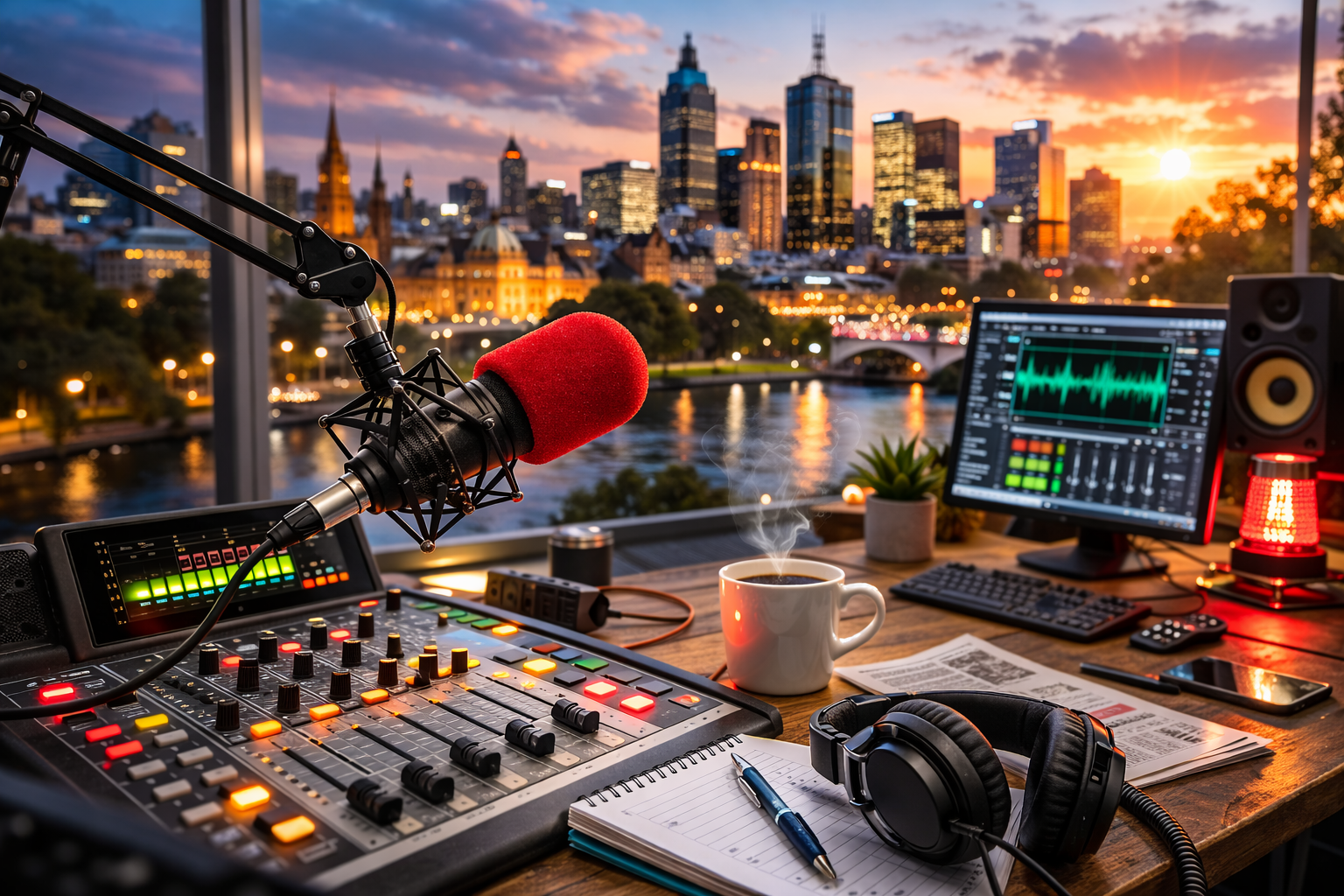
There are easier things to explain than radio loyalty. Streaming makes sense. Podcasts make sense. Video clips, push alerts, live blogs, endless little updates sliding across a screen — all of that makes obvious, modern sense. And yet 774 live still matters. Not in a quaint, “aww, bless the old wireless” way. In a very real, right-now, Melbourne-still-needs-this way.
When people search “774 live,” they often think they’re looking for a stream. A button. A player. Something practical. And yes, that’s part of it. The live stream is the point of entry now for a lot of people. But what they’re really reaching for is bigger than a stream. They’re reaching for a civic habit. A familiar voice. A station that still feels like Melbourne listening to itself.
That may sound a bit sentimental. Maybe it is. But it’s also true.
So what is 774 live, exactly?
In the simplest terms, 774 live is ABC Melbourne’s live radio service — historically tied to the 774 AM frequency and now also streamed through ABC listen. That dual identity matters. The station is old enough to carry deep habit, but current enough to live comfortably inside app culture. It has one foot in the classic local-radio world and the other in on-demand digital listening.
And that mix is a huge part of why it still works. For some listeners, 774 is literally the station that comes on in the kitchen or car because it always has. For others, especially younger or more mobile listeners, it’s not about AM at all. It’s an app icon. A live feed. A way to check in with what Melbourne is talking about without needing to sit by a radio cabinet like it’s 1962.
The platform changed. The function didn’t.
ABC’s current pages frame it plainly: ABC Melbourne live audio, current shows, upcoming programs, local stories, contact details and a visible pathway into the live broadcast. That’s not flashy. But local radio usually works best when it doesn’t try too hard to look flashy. It works when it feels usable.
| Part of 774 live | What it gives listeners | Why it still matters |
|---|---|---|
| 774 AM identity | A familiar local radio home for Melbourne audiences | It keeps the station anchored in place and memory |
| ABC listen live stream | Easy access on phone, tablet or computer | It lets the station travel with listeners rather than stay in one room |
| Local talk and current affairs | Daily discussion about Melbourne, Victoria and national issues | It gives the city a shared conversational space |
| Talkback and text | Direct audience participation | It makes the station feel less like a feed and more like a community forum |
| Listen-back and story clips | Catch-up access to interviews and segments | It helps live radio keep pace with modern listening habits |
It’s not just radio. It’s city infrastructure, really
That may sound a bit dramatic, but hear me out. People often talk about roads, trains, power, hospitals and broadband as infrastructure. Fair enough. But media can be civic infrastructure too, especially local live media. When things happen fast — storms, transport blow-ups, policy changes, public confusion, emergencies, local outrage, community grief — a city needs somewhere to process what’s going on in real time.
That is one of the jobs 774 live still does. Not perfectly every day, obviously. No broadcaster gets that luxury. But the station gives Melbourne a running public conversation that is broader and steadier than most social platforms, and more local than most national outlets can manage.
And that function becomes clearer during disruption. When the city is rattled, people still reach for something that talks back in a human voice. Not a scrolling wall of fragmented updates. A voice. A host. A sequence. A conversation that can hold information, reaction and context in the same place.
That is why local radio often looks old-fashioned right up until the moment everyone suddenly needs it.
- It helps people understand what is happening nearby, not just somewhere abstractly “in the news.”
- It gives officials, experts and listeners a shared space in moments of confusion.
- It can move from hard information to lived reaction without snapping the tone in half.
That last part matters more than it sounds. Cities don’t only need facts. They need somewhere to absorb the emotional weather around the facts too.
The lineup tells you what kind of station it wants to be
Current ABC Melbourne pages make the station’s shape pretty clear. Melbourne Breakfast is fronted by Bob Murphy and Richelle Hunt. Melbourne Mornings is with Rafael Epstein. The Conversation Hour is with Mary Gearin. Victorian Afternoons is with Brigitte Duclos. Melbourne Drive is with Ali Moore. Then there’s the handover into evening and overnight programming. It’s a lineup built around flow rather than random noise.
That matters because live radio is not only about individual talent. It’s about the feel of the day. Breakfast asks different things from a host than mornings do. Drive needs a different tempo from evenings. The station works when those transitions feel natural — like the city moving through its own rhythms rather than being hurled between incompatible personalities.
And 774 has long understood that local radio is partly about companionship by time slot. Breakfast is not simply a show. It is a routine. Mornings are not just analysis. They are what people work beside. Drive is not merely a recap. It is the sound of people returning from one part of life to another.
That’s why hosts matter so much here. They are not just presenters. They are timekeepers for a city’s daily mood.
| Program block | Current host | What listeners usually want from it |
|---|---|---|
| Melbourne Breakfast | Bob Murphy and Richelle Hunt | A smart local start, practical updates and a sense of the city waking up |
| Melbourne Mornings | Rafael Epstein | Longer talk, sharper interviews and real local scrutiny |
| The Conversation Hour | Mary Gearin | A wider lens, social texture and ideas with room to breathe |
| Victorian Afternoons | Brigitte Duclos | A broad state focus with a calmer, more reflective daytime pace |
| Melbourne Drive | Ali Moore | Context, commuter rhythm and the day’s sharper edges brought together |
Why the intimacy of radio still beats “content”
There’s a reason people use the word “content” a bit reluctantly when they talk about good radio. Content is a broad, slightly lifeless word. It can mean a panel clip, a recipe video, a weather update, a prank reel, a shark attack explainer or a branded wellness monologue. Radio, especially local live radio, often feels like something else entirely.
It feels closer. Less performative. Less shiny. More useful.
And maybe that’s the real edge 774 live still has. It doesn’t need to pretend the listener is an audience segment being optimised. It can just sound like a city speaking. That sounds simple. It’s not. Most media now is built around attention capture. Good radio is built around attention keeping. There’s a big difference.
One tries to jolt you. The other keeps you company long enough that you don’t notice how long you’ve been there.
Also, radio can do emotional moderation in a way other media struggle with. It can hold seriousness without becoming visually overwhelming. It can be intimate without becoming invasive. It can make room for a pause. In a crowded media diet, that pause is gold.
- Live radio lets people feel connected without needing to stare at a screen.
- It can sit in the background until suddenly it becomes the centre of your attention.
- It builds familiarity through voice, timing and repetition rather than visual branding tricks.
That last bit is probably why listeners can become so oddly loyal. They’re not following a logo. They’re following a relationship.
Melbourne’s a radio city, whether it admits it or not
Some cities look like television cities. Some look like newspaper cities. Melbourne has always had something of a radio city about it. A talk city. A city that likes a running argument, a local digression, a weather gripe, a thoughtful rant, a longish interview that turns unexpectedly revealing halfway through. It suits the medium.
That’s partly why 774’s format feels culturally right here. Melbourne is full of people who want detail, but not always drama. Opinion, but not just empty heat. Local focus, but not narrow-mindedness. In the best moments, 774 live can carry all that at once. It can do potholes and parliament, footy and theatre, rainfall and rent, council headaches and state transport chaos, all inside the same broader civic voice.
That range matters. Local radio dies if it becomes too small. It also dies if it becomes so broad that place disappears. 774’s trick, when it’s working well, is that it feels recognisably Melbourne without getting stuck in a parody of Melbourne-ness.
That takes discipline. And probably a bit of instinct too.
The 100-year story is not just nostalgia
ABC’s own 2024 centenary reflection on radio in Melbourne is useful because it reminds people that 774 is not a random surviving frequency. It comes from a long line, back to 3LO and Broadcast House, through decades of presenters, producers, callers, routines and technological change. The station’s history is deep. But the reason that matters is not only heritage. It’s continuity.
When a local station lasts a century, it becomes more than a channel. It becomes part of how a city hears itself across generations. Grandparents knew the sound of local radio. Parents did. Plenty of younger listeners now find it again through apps rather than AM dials, but the basic role is still recognisable.
That continuity gives 774 something digital-native media rarely gets to claim: institutional memory. Not in a pompous way. More in a practical way. The station knows what Melbourne sounds like when it panics, laughs, mourns, argues, floods, votes, celebrates and complains. That memory is a kind of editorial asset.
And yes, it can sometimes make the station feel old-school. But old-school is not always an insult. In broadcasting, it can also mean seasoned, steady and not easily knocked off balance by every passing platform trend.
The live bit is what keeps it alive
This may be the whole story in one sentence: 774 works because it is live. Or at least because live remains the heart of it.
Podcasts are great. Catch-up clips are useful. On-demand audio is now normal. But live radio creates a specific feeling nothing else fully copies. You know others are hearing it now. You know a caller has just said that. You know a host is reacting in real time. You know traffic, weather, politics, a power outage or a local story can change the texture of the broadcast mid-flow. That unpredictability is not a flaw. It is the oxygen.
And there’s another subtle thing. Live radio creates mild accountability. Not perfect accountability, obviously, but some. When something is happening now, and the audience can answer back now, the broadcaster cannot retreat entirely into polished distance. That matters in talk media.
The live setting also gives local stations their emotional voltage. A city is not static, and live radio can catch that movement in a way edited media often smooths away. It is less manic than social media, but still immediate. Less produced than a podcast, but not as chaotic as open-platform chatter. That in-between space is where 774 still earns its keep.
There’s also the caller factor — messy, human, irreplaceable
Talkback gets mocked a lot, and sometimes fair enough. It can be repetitive. It can wander. It can produce some absolute howlers. But a city without caller radio loses something. It loses texture.
Because the caller is where local radio stops being a polished service and starts becoming a public square. Not an ideal public square — those don’t exist — but a live one. The caller brings mood, impatience, wit, anger, confusion, anecdote and local knowledge in a form no scripted broadcast ever can.
That’s why 774’s talkback and text lines still matter. They’re not just interaction tools. They’re evidence that the station still sees listeners as participants, not just consumers. You can hear when a station believes that, and you can definitely hear when it doesn’t.
And yes, sometimes callers are wrong. Sometimes gloriously wrong. But that’s part of the point too. Local radio is not meant to sound like a sealed document. It’s meant to sound like people thinking in public.
Can 774 keep mattering in the streaming era?
Yes — but not by pretending it’s still 1998. The station’s future probably depends on doing more of what it already does well while staying easy to find, easy to stream and easy to clip. The live feed matters. The app matters. Listen-back matters. Social discoverability matters too, even if radio people sometimes roll their eyes at that phrase.
But none of those things matter as much as the core question: is the station still useful when Melbourne needs a trusted local voice? If the answer stays yes, then the platform details are manageable.
That is why 774 live still has a future. Not because legacy alone will carry it. Legacy never carries anything for long. It has a future because local live radio still answers a basic need that the media market has not solved away. People want to know what’s happening around them, and they want someone credible to help make sense of it without turning every moment into performance art.
FAQ
What does “774 live” mean?
It refers to ABC Melbourne’s live radio broadcast, historically known through the 774 AM frequency and now also streamed through ABC listen.
Can you still listen to 774 on your phone?
Yes. ABC Melbourne is available live through the ABC listen platform, which is now a major entry point for many listeners.
Why is 774 still important in Melbourne?
Because it gives the city a trusted local voice for news, conversation, emergencies, talkback and the everyday texture of civic life.
Is 774 only for older listeners?
No. It has deep habit among long-time listeners, but streaming has made it more accessible to people who don’t think in terms of AM radio at all.
What kind of programs define the station?
Its day is built around local talk and current affairs, including Breakfast, Mornings, The Conversation Hour, Afternoons and Drive.
Why does live radio still feel different from podcasts?
Because it happens in real time, carries local mood, allows audience participation and gives listeners a sense that other people are hearing the same thing right now.
How long has ABC Radio Melbourne been around?
ABC’s own 2024 coverage marked 100 years of radio in Melbourne, tracing the station’s history back to 3LO.
Conclusion
774 live still matters because it offers something a lot of modern media keeps promising but rarely delivers: a steady, local, human sense of connection. Not everything has to be a clip. Not every update needs to be dressed as a spectacle. Sometimes people just want to hear the city think out loud — clearly, calmly, imperfectly, but together.
That is what ABC Melbourne still does at its best. It gives people a place to check in, tune in and orient themselves. Sometimes that means breaking news. Sometimes it means a smart interview. Sometimes it’s a caller making a sharp point about trams, schools, weather, politics or footy. Sometimes it’s just the comfort of a known voice at a known hour.
And that may be the clearest answer to why people still search “774 live.” They’re not only looking for a broadcast. They’re looking for a place in the media where Melbourne still sounds like Melbourne. That’s not a small thing. It’s the whole point.