
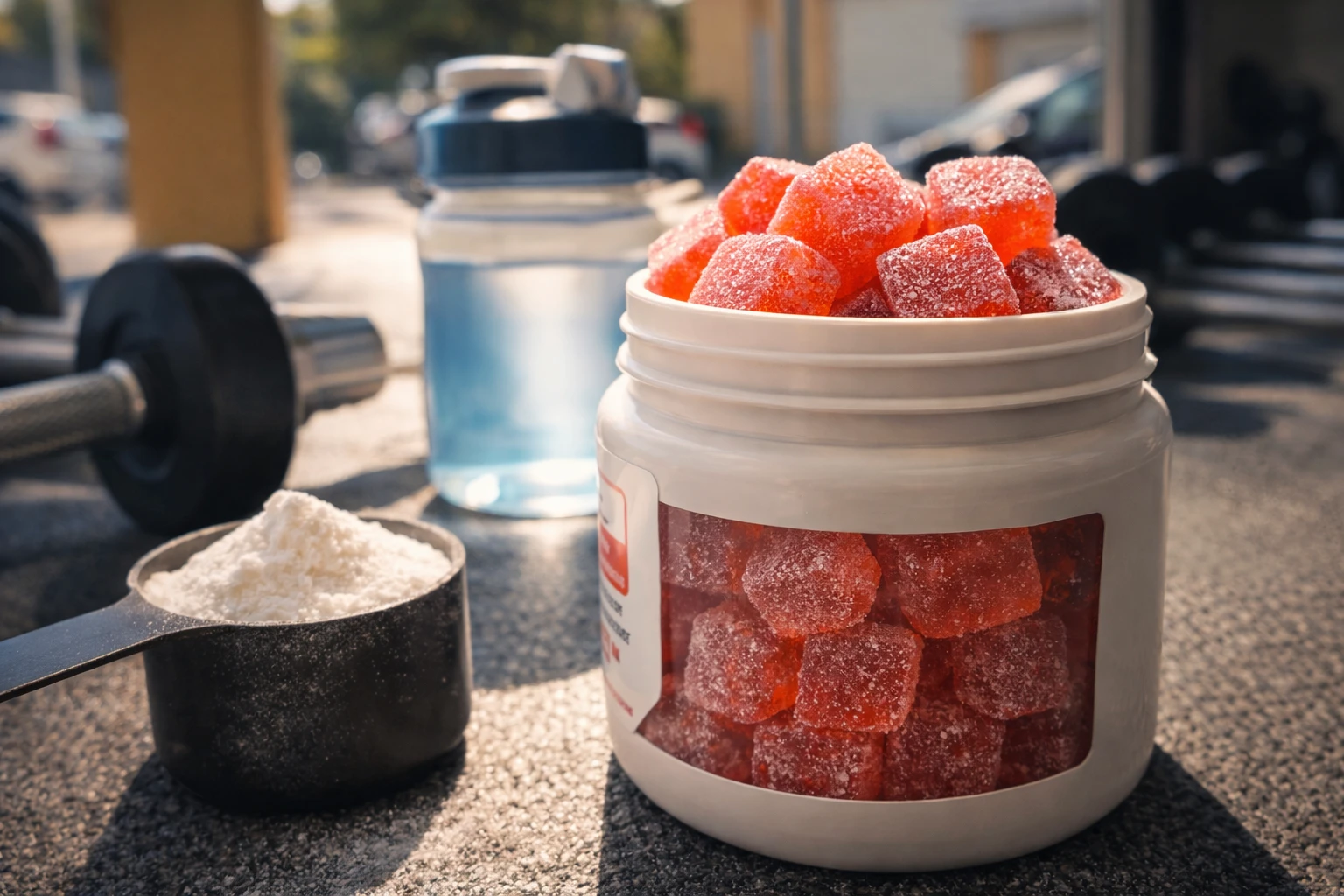
Creatine gummies have landed in that very modern sweet spot where fitness, convenience and candy-looking packaging all meet. You’ve probably seen them. Bright tubs. Bold claims. Easy daily habit. No shaker bottle. No chalky powder. No weird scoop living at the bottom of a gym bag like a tiny plastic relic from three workouts ago.
But here’s the catch. Creatine gummies are not really a new ingredient story. They are a delivery-format story. And that difference matters.
The real question is not “do gummies work?” in some vague magical sense. The real question is: if the gummy contains enough creatine monohydrate, and if you take enough of it, and if it has been stored well, is it as useful as the boring old powder? That’s a much better question. It’s also the one that saves people money.
For Australians, there’s another wrinkle. Heat matters here. Storage matters here. Convenience matters here because a lot of people train before work, after work, outdoors, in footy season, in garage gyms, in shared flats, in cars that get properly cooked in summer. So the creatine gummies question isn’t silly at all. It’s practical.
And the honest answer is this: creatine gummies can be fine, but they’re rarely the most evidence-backed, most flexible or most cost-effective version of creatine. They’re mostly about convenience. Sometimes that convenience is worth it. Sometimes it absolutely isn’t.
Let’s start with the boring truth: creatine itself is not the issue
If you strip away the format, the colour, the flavour and the marketing language, the core ingredient that matters is creatine monohydrate. That’s the form with the strongest evidence behind it. The Australian Institute of Sport puts creatine monohydrate in Group A, which is its category for supplements that can have a specific use in sport when used properly. That’s not hype language. That’s the practical, slightly no-nonsense Australian sport-science view.
Creatine helps top up the phosphocreatine system in muscle. That’s the quick-energy system used in short, sharp, high-intensity efforts. Sprinting. Repeated lifting. Power work. Team-sport bursts. Hard intervals. Big efforts that live in those short explosive pockets where your body burns through immediate energy fast.
That’s why creatine has lasted. It is not new. It is not fashionable because it’s mysterious. It is fashionable because it keeps surviving scrutiny.
So yes, creatine works. That part is not really the debate anymore. The debate is what form makes the most sense for a real person living a real life. That is where gummies enter the chat.
| Question | What matters most | Why it matters |
|---|---|---|
| Does creatine help? | Creatine monohydrate has the strongest evidence | It is the best-studied form for performance and muscle creatine loading |
| Do gummies change the science? | No, the key issue is still the creatine dose and form | A gummy is a delivery format, not a new performance mechanism |
| Is convenience a real benefit? | Yes, especially for people who hate powders | Consistency often beats perfection in everyday supplement use |
| Is powder still the reference point? | Yes | Most of the evidence base and practical guidance still sits with powder |
So what are creatine gummies actually good at?
Convenience. That’s the first and biggest thing. And honestly, it’s not nothing.
Some people never stick with powder. They forget it, hate the taste, hate the texture, don’t want to mix it, or can’t be bothered carting it around. For those people, a gummy can solve the real problem, which is not science. It’s compliance. The best supplement on earth does nothing if it sits untouched in a cupboard next to three abandoned blender bottles and a tub of protein that expired sometime during the Albanese government’s first term.
Gummies also feel less intimidating for people who are new to supplements. That matters more than gym veterans usually admit. Powder has a very “sport nutrition” vibe. Gummies feel simpler, lighter and less technical.
And for travel, they can be handy. No loose powder at the bottom of a bag. No scoop. No “can i take this through the airport?” panic. Just count them out and go.
- They are easy to take without mixing anything.
- They can make daily use feel more automatic.
- They’re handy for travel, work bags and people who hate shaker bottles.
That’s the good side. Now for the nuance — because there is definitely nuance.
The main problem with gummies is not what people think
A lot of people assume the issue is absorption. Usually, it isn’t. Creatine monohydrate is already very well absorbed. That’s one reason the Australian Institute of Sport keeps coming back to it. The real issue with gummies is usually dose density and format practicality.
Here’s what i mean. Evidence-based maintenance use is commonly around 3 to 5 grams a day. If a gummy product gives only a modest amount per piece, you may need several gummies every day to land in the useful range. That is not inherently bad. It just means you have to read the label like an adult, not like someone buying lolly snakes at the servo.
And this is exactly where some products get sneaky. Not necessarily dishonest, but very presentation-friendly. Big language on the front. Small amount per gummy. A serving size that only makes sense if you actually count out multiple pieces. Before you know it, the tub looks cheap and cheerful but delivers fewer effective daily serves than you assumed.
That’s why the smartest way to judge creatine gummies is not by flavour or aesthetic. It’s by math.
How many grams of creatine monohydrate do you get per full daily serving? How many gummies does that take? How many serves are really in the tub? And what does that cost compared with plain powder?
That’s the whole game, really.
And then there’s the Australia problem: heat
This is where the Lifestyle, Health & Weather angle stops being decorative and starts becoming genuinely useful. Australia is not gentle on stored products. Cars get hot. Backpacks get hot. Garage gyms get hot. Apartment windowsills get hot. Beach bags get absurdly hot. That matters because creatine is most stable in solid form and less stable once it sits in solution or in conditions that push degradation harder.
Now, gummies are still a solid format, not a sports drink. So i’m not saying they melt into uselessness the second Brisbane hits 33 degrees. But I am saying that format and storage deserve more thought here than many people give them. Supplements that live in a hot car or on a sunny kitchen bench are not being treated kindly. That’s true of lots of products, not just creatine.
It’s also why plain powder continues to have such a strong practical case. It’s simple, stable in dry form, easy to store, and backed by the bulk of the evidence. That doesn’t make gummies bad. It just means gummies are asking for a bit more real-world care than their candy vibe suggests.
And while we’re on heat, let’s kill a common myth properly: reliable sport-science guidance does not support the old claim that creatine monohydrate inherently causes dangerous thermoregulatory dysfunction. That scare has hung around for years. It keeps resurfacing every summer. It is still not well supported. The more honest take is simpler: hard training in Australian heat is hard training in Australian heat. Hydration, timing, clothing, shade and common sense still matter. Creatine doesn’t replace any of that, and it doesn’t exempt you from it either.
| Real-world issue | Powder | Gummies |
|---|---|---|
| Evidence base | Strongest and longest | Rides mostly on the creatine ingredient, not gummy-specific research |
| Dose flexibility | Easy to adjust to 3 g, 5 g or a loading protocol | Depends on how much creatine is packed into each gummy |
| Convenience | Lower unless you don’t mind mixing | Very high |
| Storage simplicity | Usually very simple in dry conditions | Still simple, but less ideal if regularly left in heat |
| Cost per useful dose | Usually lower | Often higher once you calculate daily grams properly |
| Extra ingredients | Often minimal | May include sweeteners, flavours, gelling agents and other add-ons |
If the gummies are good, what should be on the label?
This is where people can save themselves from wasting money. You do not need a chemistry degree. You just need to slow down for 40 seconds in front of the label.
First, check the form. You want creatine monohydrate, not some “advanced matrix” language trying to make basic chemistry sound like a Marvel franchise. The evidence still points back to monohydrate.
Second, check the total grams of creatine in one full serving, not per single gummy unless that single gummy happens to be the full serving. Those are not always the same thing, and marketers know that consumers often stop reading early.
Third, check how many gummies you would need each day to land at a useful maintenance dose. If it takes a weirdly large handful, you should at least know that before you buy it.
Fourth, check the extras. Sweeteners. Sugar alcohols. Sugars. Flavours. None of that is automatically evil. But if you’re someone who gets gut issues, or you plan to take these daily, the extras matter more than they would in a once-in-a-while treat.
- Look for creatine monohydrate as the form.
- Look at total grams per full serve, not just per piece.
- Check how many gummies you need to reach a practical daily dose.
That’s it. If a product still looks good after those three checks, you’re at least asking the right questions.
Do you need a loading phase with gummies?
Technically, the creatine science does not change because the delivery format looks more cheerful. A loading phase is still a loading phase. If someone wants to saturate muscle stores faster, the common guideline is about 5 grams four times a day for around five days, followed by a maintenance dose. Or they can skip loading and simply take 3 to 5 grams daily, reaching saturation more gradually over several weeks.
But here’s the practical issue. Gummies can make loading awkward. Not impossible. Just awkward.
Why? Because a loading protocol with gummies may mean eating quite a lot of gummies each day, depending on the product. That can be expensive, annoying, and for some people a fast track to stomach complaints or simple gummy fatigue. At a certain point, the convenience argument can flip on itself.
So for most everyday gym-goers, if they do pick gummies, the calmer move is usually the simple maintenance approach. Take an effective daily dose consistently. Don’t overcomplicate it. Don’t turn your supplement routine into a confectionery challenge.
That approach is less dramatic. It’s also usually more realistic.
What about bloating, weight gain and stomach issues?
This is where the internet gets a bit noisy, so let’s keep it clean. Creatine can cause acute weight gain, mostly because it pulls more water into muscle. That is not the same thing as suddenly getting “fat,” even though some people react emotionally when the scale nudges up. If you start creatine and the number moves a bit, that is not automatically bad news. In some contexts, it is expected.
Gastrointestinal upset can happen too. The Australian Institute of Sport explicitly mentions GI distress as one of the main practical considerations. That doesn’t mean everyone gets it. Plenty of people don’t. But if you’re already sensitive to sweeteners, gels or concentrated supplements, gummies are not automatically the gentler option just because they look easier.
Sometimes powder in smaller divided doses sits perfectly well. Sometimes gummies are fine. Sometimes people discover, slightly too late, that the “fun” format was only fun until the gut got involved.
That’s why honesty matters here. Creatine is not dramatic for most people, but it is not invisible either.
Are gummies better for women, beginners or older adults?
This is the sort of marketing question that often gets answered badly. Gummies are not inherently better for women. They are not inherently better for beginners. They are not inherently better for older adults. They may simply be more approachable for some people.
That’s a different claim. And a much more believable one.
Beginners often do better with whatever format they will actually take daily. For some, that will be powder. For others, a gummy is less of a psychological hurdle. Older adults who are curious about creatine may also prefer a simpler-feeling format, though the actual utility still comes back to dose, tolerance and consistency. Women may like gummies for the same reason anyone might: convenience, portability and habit. But the underlying creatine physiology does not suddenly change because the supplement looks less like gym powder.
That said, it is worth noting that creatine is no longer just a “blokes lifting heavy things” supplement. Sport-science interest has widened. There is growing discussion around cognitive support, aging, recovery and female athletes, even though the deepest and most consistent evidence base remains performance-oriented. That broader interest is one reason gummies have started finding lifestyle market space in the first place.
Still, the same rule applies: if the science is mostly on monohydrate, don’t get hypnotised by the format.
Where gummies make sense — and where they don’t
There are definitely people for whom creatine gummies make perfect sense. Busy people. Travellers. People who always forget powder. People who hate mixing supplements. People who don’t want another container on the kitchen bench. People who would happily pay a little extra for less friction.
But there are also plenty of people for whom gummies are a detour, not an upgrade. If you want the most evidence-backed, cheapest, most adjustable version, powder still wins. If you are planning a loading phase, powder is much easier. If you are already dealing with sweetener-related stomach drama, gummies might not be your friend. If you live somewhere very hot and tend to leave things in the car, gummies are not exactly screaming “optimal storage behaviour.”
That’s why the sensible answer is not that gummies are good or bad. It’s that they are optional. And optional things should earn their place.
FAQ
Do creatine gummies work as well as powder?
They can work if they deliver enough creatine monohydrate and you take an effective daily dose. The issue is not the gummy itself but the form, dose and consistency.
Is creatine monohydrate still the best choice?
Yes. That is still the form with the strongest evidence behind it and the one Australian sport-science guidance leans on most heavily.
How much creatine should most people take?
A common maintenance approach is 3 to 5 grams a day. Some people use a short loading phase first, but daily maintenance alone also works over time.
Are creatine gummies better for beginners?
Not biologically. They may just feel easier to use, which can help beginners stick with the habit.
Can creatine make you hold more water?
Yes. Acute weight gain can happen because creatine increases water stored in muscle. That is a known effect, not a sign that the supplement is somehow failing.
Do creatine gummies matter more in hot Australian weather?
Storage matters more in hot weather, and hydration still matters for training. Creatine itself is not well supported as a cause of dangerous thermoregulation problems, but common sense in heat still applies.
What is the biggest downside of gummies?
Usually cost and dose density. Some products need multiple gummies to reach a useful daily intake, and that can get expensive fast.
Conclusion
Creatine gummies are not nonsense. Let’s start there. They can be a perfectly workable way to take creatine if the label is solid, the dose is real, the product is stored sensibly and the convenience genuinely helps you stay consistent.
But they are not some clever new shortcut past the usual rules. The science still points back to creatine monohydrate. The evidence still leans hardest on powder. And the real questions are still basic ones: how much creatine are you getting, how often will you actually take it, how much are you paying, and are you making life easier or just making supplementation look prettier?
That is the honest Australian answer, really. If gummies help you take creatine properly, great. If they cost more, deliver less and sit melting in a gym bag in February, maybe not. The best format is the one that gets the boring stuff right. And with creatine, the boring stuff is still what works.