Unlocking the Mystery of the Min Min Lights
Hey guys, look, if you have ever spent any serious time in total, absolute darkness, you know your eyes start playing wild tricks on you. The famous min min lights are the perfect example of this. I remember sitting through the rolling power outages in Ukraine a few years ago. You would look out the window into the pitch-black steppe, and every distant flashlight, passing car, or stray reflection looked like a UFO landing. Your brain just scrambles for data. But honestly, that is absolutely nothing compared to the eerie, glowing orbs people chase in the Australian Outback. These things are not just your standard campfire reflections or tired eyes acting up. They are a legitimate, documented phenomenon that has puzzled solitary travelers, indigenous folks, and hardcore academics for well over a century.
You are probably wondering what exactly they are, why they seem to follow moving vehicles, and if you can actually go out there and see them yourself. My thesis here is super simple: whether you firmly believe they are ancestral spirits, complex optical illusions, or some crazy bioluminescent bugs, understanding this mystery requires a blend of hard atmospheric science and open-minded adventure. I am going to walk you through exactly what these glowing spheres are, where they come from, and how you can prep yourself for a potential encounter. Grab a coffee, get comfortable, and let’s talk about the absolute weirdest natural light show on planet earth.
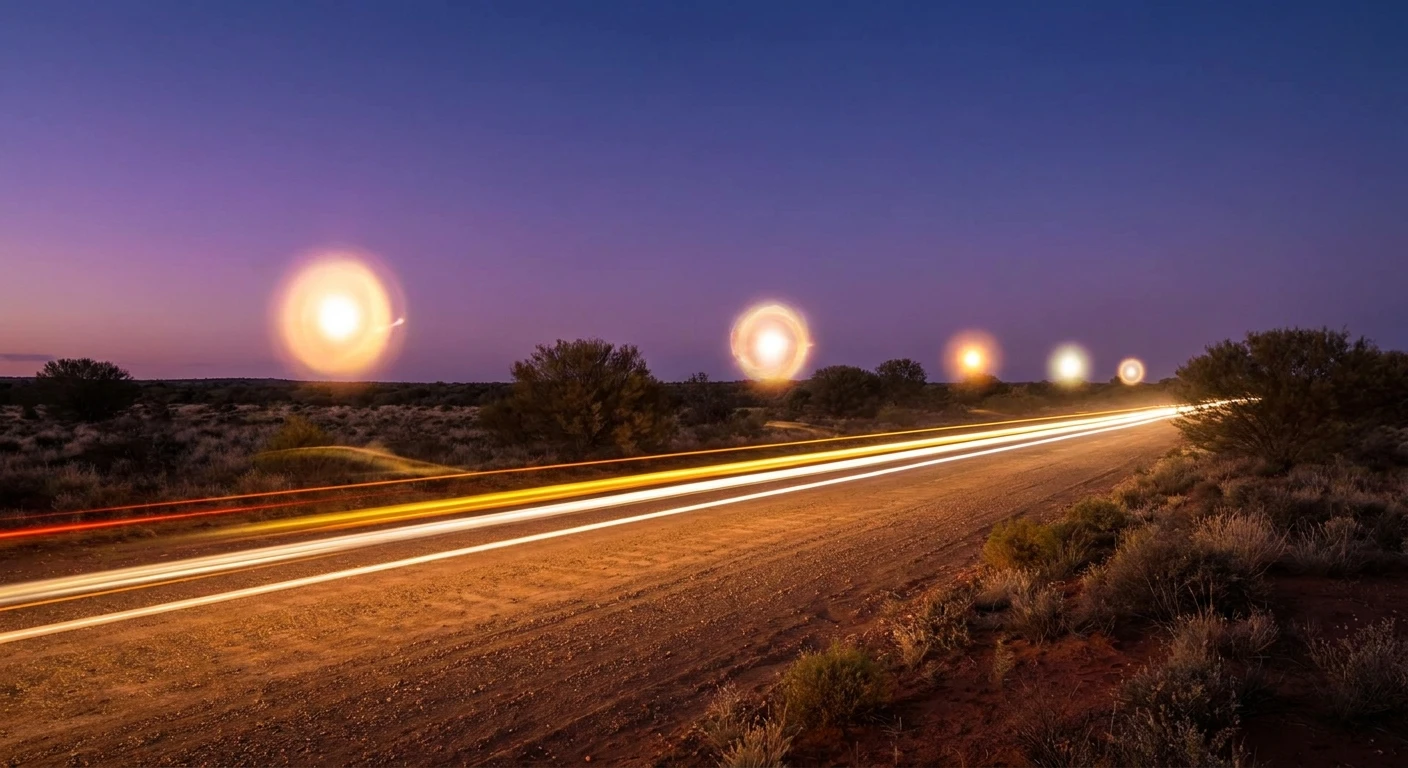
So, what actually happens when you encounter this stuff out in the wild? Imagine driving down a lonely, unsealed dirt road somewhere deep in western Queensland. Suddenly, a fuzzy, disc-shaped light appears in your rearview mirror. You speed up, the light speeds up. You slam on the brakes, the light stops dead. It is incredibly unnerving but strangely mesmerizing at the exact same time. Understanding the mechanics of these sightings provides immense value for both off-grid travelers and folklore enthusiasts alike. For instance, a landscape photographer can capture award-winning long-exposure shots by knowing when and where to set up their rig. Alternatively, an atmospheric science student gets a real-world case study in thermal refraction without needing a million-dollar lab setup.
Let’s break down the typical characteristics of these encounters so you know what to look for.
| Encounter Type | Typical Visual Profile | Common Viewer Reaction |
|---|---|---|
| Stationary Orb | Soft white or yellow glow, hovering near the horizon | Curiosity, stopping the vehicle to take photos |
| Pursuit Light | Bright red or green, seemingly mirroring the car’s speed | Panic, accelerating to escape the area |
| Splitting Lights | Single orb that divides into two or three smaller lights | Extreme confusion, questioning reality |
If you want to maximize your chances of spotting one safely without ending up lost in the bush, you need a solid strategy. Here are the core rules you absolutely must follow:
- Know your terrain backwards and forwards: The Outback is unforgiving. Never drive off the main tracks chasing a light, because you will get bogged or lost.
- Check the weather conditions: These phenomena usually happen on clear, cold nights after a very hot day. That temperature shift is totally key to the whole experience.
- Stay inside your vehicle: If you see something weird, observe it from the safety of your car. There are plenty of venomous snakes and hazards out there that are much more dangerous than a floating light.
- Bring professional optical gear: Binoculars or a telephoto lens can help you figure out if you are looking at an atmospheric mirage or just a very distant road train.
Origins of the Phenomenon
To really get what is going on, we have to go back to the very beginning. Long before European settlers brought their cattle and roads to Australia, the indigenous peoples of the region had plenty of stories about strange glowing spheres. In local Aboriginal folklore, these lights were often thought to be the spirits of the dead or warning signs from ancestors telling people to stay away from certain sacred or dangerous areas. The name itself, however, comes from a very specific and tragic location: the old Min Min Hotel. Back in the early 1900s, this was a remote pub and mail exchange in Queensland. It was a rough place, prone to violence and despair, and eventually, it burned down. Legend has it that shortly after the hotel was destroyed, a stockman was riding past the ruins and was chased by a glowing orb. He told the story at the next town, and the name stuck forever.
Evolution of the Legend
As the 20th century rolled on, the outback became crisscrossed with long-haul truckers, sheep shearers, and traveling salesmen. Naturally, the stories spread like wildfire. Sitting around campfires, stockmen would swap terrifying tales of driving a dusty Ford through the middle of nowhere and having a bright green sphere pace their truck for fifty kilometers. The legend evolved from a localized ghost story into a massive cultural touchstone for rural Australians. It became a rite of passage. If you spent enough time in the channel country, you were bound to see one. The narratives became more elaborate, with people claiming the lights could read their thoughts or that they intentionally ran people off the road.
Modern State of the Mystery
Fast forward to the present day, and the town of Boulia in Queensland has entirely embraced its status as the epicenter of this weirdness. They have museums, animatronic shows, and festivals all dedicated to the lore. But it is not just tourism. With the explosion of cheap drones, LED flashlights, and ultra-bright vehicle light bars, modern sightings are heavily contaminated. It is harder than ever to separate genuine, unexplained atmospheric events from some guy flying a DJI drone a few miles away. Yet, even with all our tech, completely unexplainable sightings continue to pour in from reliable witnesses who know the difference between a quadcopter and a real anomaly.
The Fata Morgana Mirage
Okay, let’s talk hard science. The most widely accepted explanation among academics is a specific type of optical illusion called a Fata Morgana. So, imagine light is a lazy driver; it always takes the path of least resistance. On a typical day, air gets cooler the higher up you go. But in the Outback, you often get extreme temperature inversions. The ground cools down incredibly fast at night, trapping a layer of freezing air right on the dirt, while a layer of warm air sits on top of it. When light from a very distant source—like a truck’s headlights over the curvature of the earth—hits that boundary between cold and warm air, it bends sharply downward. Your brain, which assumes light travels in straight lines, projects that image up into the sky. When the distant truck moves, the mirage moves. When you move, your angle to the refraction changes, making it look like the light is reacting directly to you.
Bioluminescence and Seismic Activity
But the mirage theory does not explain everything, especially the reports of lights hovering just a few feet off the ground right in front of people. Some researchers argue for a biological answer, like swarms of bioluminescent insects, particularly a type of glow-worm or firefly that might swarm in massive, dense balls. Another wild but scientifically grounded theory involves piezoelectricity. The Earth’s crust is always shifting, and when quartz-heavy rocks in the outback grind together under immense pressure, they can generate massive electrical charges that manifest as floating plasma or ball lightning above the ground.
- A Fata Morgana happens when light refracts through layers of air with wildly different temperatures, bending images over the horizon.
- Light naturally travels faster in warm, less dense air than it does in cold, dense air, causing the optical bending.
- Seismic strain in specific fault lines can produce piezoelectric charges, ionizing the air to create temporary, glowing plasma spheres.
- Swamp gas (methane) ignition is often cited, but the dry conditions of the Outback make this highly unlikely compared to wetter environments.
Day 1: Gear Preparation
If you are serious about tracking these things down, you need a solid plan. Start by gathering your gear. You will want a robust 4WD vehicle, multiple spare tires, satellite communication devices, and serious camera gear. Ditch the smartphone for night photography; you need a DSLR or mirrorless camera with a fast lens and a heavy-duty tripod. Pack enough water for a week, even if you are just going for a few days.
Day 2: Route Planning
Map out your drive. The ultimate hotspot is the stretch of road between Winton and Boulia in Queensland. Plan your driving times so you are resting during the brutal heat of the day and actively patrolling the roads between 10 PM and 3 AM. Make sure you mark out fuel stops, because gas stations are few and far between out there.
Day 3: Arriving in Boulia
Once you hit town, drop by the local visitor center. The locals know the current road conditions and weather patterns better than any app. Check into your accommodation, grab a meal at the pub, and casually ask the bartender if there have been any recent sightings. You would be surprised how much fresh intel you can get just by buying someone a beer.
Day 4: The First Night Drive
Head out on the Donohue Highway just after midnight. Drive slowly, keep your cabin lights totally off, and pull over safely every twenty kilometers to just sit and watch the horizon. Give your eyes at least thirty minutes to adjust to the true darkness. Do not let your brain jump to conclusions at the first sign of a star or satellite.
Day 5: Adjusting for Weather
If night one was a bust, check the temperature gradients. You need a massive drop in temperature after sunset to get those refraction layers going. If it is windy, the air layers will mix, and you will not see a mirage. Wait for a perfectly still, freezing cold night to maximize your atmospheric odds.
Day 6: Interviewing Locals
Take a break from the night shift and spend the day talking to station owners or roadhouse operators. The people who drive these roads every single night of their lives have the most credible stories. Ask them specifically where the lights tend to originate from, as many claim they spawn near specific ridges or dry creek beds.
Day 7: Documenting the Evidence
If you are lucky enough to spot one, do not panic. Set up your tripod immediately. Manually focus your lens to infinity, open up the aperture, and shoot a series of long exposures. Take detailed notes: what time is it, what is the temperature, is there any noise, and exactly what color is the light? This data is pure gold for researchers.
Myth: They are aggressive extraterrestrial ships trying to abduct drivers.
Reality: There has never been a single credible report of a vehicle being damaged, abducted, or physically touched by these lights. The aggressive following behavior is just a trick of geometry and optics shifting as you drive.
Myth: You can catch them if you drive off-road fast enough.
Reality: Because they are highly likely to be optical illusions, you can never physically reach them. Just like a rainbow, the light will constantly recede from you at the exact same speed you approach it.
Myth: They only exist in Australia.
Reality: While this specific name is Australian, identical phenomena exist globally, such as the Marfa lights in Texas or the Hessdalen lights in Norway. The physics creating them are universal.
Myth: They make a loud buzzing sound when they get close.
Reality: Almost all verified witness accounts specifically mention the eerie, absolute silence of the outback during an encounter.
Are they actually dangerous to humans?
No, not directly. The only real danger is human error—like panicking and crashing your car, or wandering off into the pitch-black desert and getting completely lost.
What colors do they typically appear as?
Witnesses most commonly report seeing a soft, fuzzy white or yellow glow, though bright red and neon green are also highly reported, especially during intense temperature inversions.
Can I successfully film them?
Yes, but you need a very steady tripod and manual focus. Autofocus will just hunt aimlessly in the dark, and handheld footage will just look like a blurry, bouncy mess.
Do they make any sort of noise?
No. They are completely silent, which is often what makes the experience feel so intensely creepy and supernatural to witnesses.
Are they emitting radiation?
No radiation has ever been detected in the areas where sightings frequently occur. They are purely optical or low-level electrical phenomena.
Where is the absolute best spot to look?
The road between Winton and Boulia in western Queensland remains the undisputed capital for sightings, largely due to the flat terrain and extreme weather shifts.
What time of night is best?
Midnight to 3 AM is the golden window. This is when the ground has cooled down sufficiently to create the intense atmospheric layers needed for mirages.
Do they actually chase people?
It certainly feels like it, but it is just an optical illusion. As you move along the road, your angle of refraction shifts, making the mirage mirror your exact movements.
Will they stall my car engine?
No. Unlike Hollywood UFO movies, there are zero credible reports of electromagnetic pulses (EMP) killing car engines or draining batteries during an encounter.
Looking ahead into the rest of the decade, the mystery is far from completely solved. By 2026, mobile camera technology and consumer drones are so incredibly advanced that we are finally starting to get some decent, high-resolution data on what is happening out there in the dark. Whether it is just the weather playing tricks on tired drivers or something far more bizarre hiding in the dirt, chasing this legend is an incredible adventure. If you are ever traveling through the harsh Australian Outback, keep your eyes on the horizon. Do not let the dark scare you. Plan your trip, respect the harsh terrain, and go experience the magic for yourself!