
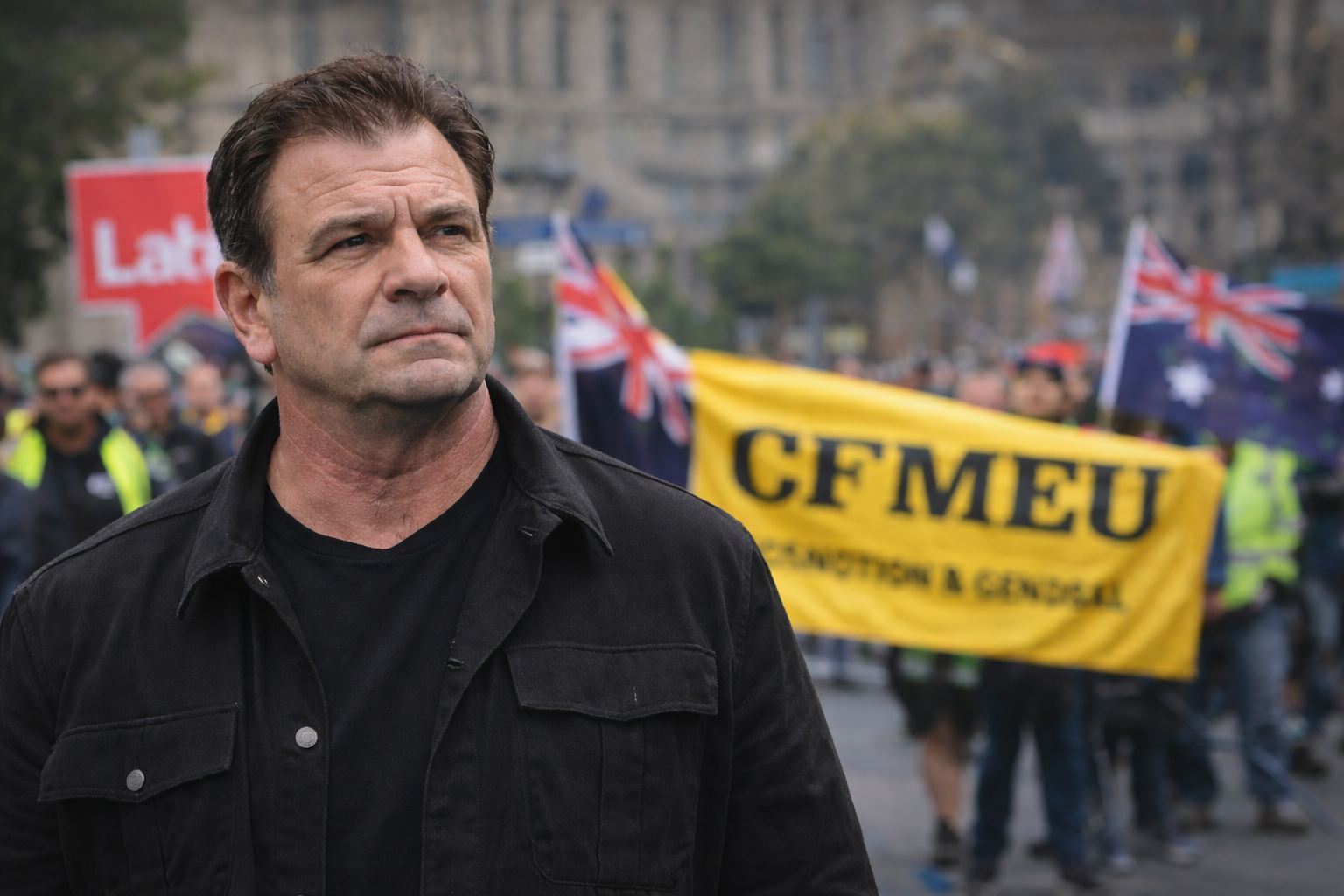
Some public figures matter because they hold office. Others matter because they shape the weather around the office. John Setka has long been in that second category. He was never prime minister, premier or cabinet minister. But for years, especially in Victoria, his name sat right in the middle of arguments about Labor, unions, building sites, public money, industrial power and who was really running the room when the microphones were off.
And honestly, that is where the John Setka story gets bigger than one man. It becomes a story about the system around him — the people who backed him, the people who feared him, the people who looked away, and the people who eventually decided the whole structure had to be ripped open and rebuilt.
That is not ordinary union gossip. That is a public-life story with real institutional weight.
First, the basic outline
John Setka became secretary of the CFMEU’s Victorian-Tasmanian branch in 2012. By the time he resigned in July 2024, he had been a union official for close to 40 years and one of the most recognisable, feared and politically charged figures in Australian industrial life. He was not some backroom operator in the quiet sense. He was visible, loud, combative and impossible to mistake for a low-profile administrator.
That visibility cut both ways. To supporters, he embodied the hard-edged, no-apologies wing of unionism — the kind that did not care much for elite approval and measured success by muscle, site power and the willingness to stare down employers, governments and critics. To his opponents, he came to symbolise something darker: a culture where brute force, intimidation and political leverage blurred into each other until the lines barely mattered.
That split has followed every serious conversation about him. He has rarely been discussed as merely a person. He has usually been treated as a signal — a sign of either militant worker strength or institutional rot, depending on where you stood.
| Key phase | What happened | Why it mattered in public life |
|---|---|---|
| 2012 | Setka became Victorian-Tasmanian CFMEU secretary | He moved from union influence to major institutional power |
| 2019 | He was expelled from the Labor Party after a long internal fight | That rupture exposed how strained the Labor-CFMEU relationship had become |
| July 2024 | He resigned as branch secretary | His fall came amid huge scrutiny over the union’s conduct and links |
| August 2024 | CFMEU Construction and General Division was placed into administration | The federal system effectively stepped in to seize control of a major union arm |
| 2025–26 | Legal action, charges and inquiry findings kept his name in the public frame | The story shifted from personality politics to institutional reckoning |
He became bigger than the job
That is one of the strangest and most revealing parts of the Setka story. At some point, the office and the man seemed to merge in the public imagination. People did not only talk about the Victorian CFMEU. They talked about “Setka’s CFMEU.” That tells you a lot.
In healthy institutions, leadership matters, but the institution still feels bigger than the individual. With Setka, the reverse seemed to happen. His personal style, his allies, his enemies, his feuds and his public persona came to shape how people understood the union itself. That may have been useful for raw authority in the short term, but it carried a risk: once the leader becomes the brand, every personal scandal and every institutional allegation start bleeding into each other.
And that is more or less what happened.
By the end, debates about him were rarely just about industrial bargaining. They were about character, conduct, culture and political protection. That is a very different register. Once a union boss becomes shorthand for an entire ecosystem of pressure and privilege, public attention gets much harder to contain.
The Labor split was a warning shot
If you want to understand why John Setka still matters politically, you have to go back to 2019. That was when his relationship with the Labor Party blew open in a way that was impossible to smooth over. Anthony Albanese moved to expel him from the ALP after reported comments about anti-violence campaigner Rosie Batty and broader concerns about Setka’s conduct. Setka fought the move in court, then dropped his appeal, and Labor formally expelled him.
That episode was not just about personal disgrace. It was a warning shot about a deeper problem. Setka’s influence had become so politically awkward that the federal Labor leader concluded it was no longer sustainable to keep him inside the party fold. That mattered because Labor and unions, especially construction unions, are not meant to be distant strangers in Australian politics. When a union leader becomes too toxic even for that relationship to hold, something serious is going on.
And there was another layer. In the same broad period, Setka’s personal legal problems were also under public scrutiny. In June 2019, he was convicted of using a carriage service to harass his wife and was placed on a good behaviour bond. That did not create the whole political rupture on its own, but it deepened the sense that the problem was not only ideological or factional. It was about judgment, conduct and limits.
- The Labor split showed that union power still has political boundaries.
- It also showed how hard those boundaries can be to enforce when a figure has deep organisational backing.
- And it revealed the gap between internal loyalty and public legitimacy.
That gap is one of the most useful ways to think about Setka. Inside parts of the movement, he had real support. Outside it, the reputational cost kept rising.
Then came the bigger collapse
For years, John Setka’s public role involved a strange balance. He was often criticised, often defended, and somehow kept standing. That is why 2024 felt different. The floor finally shifted under the whole structure.
In July 2024, Setka resigned as Victorian branch secretary, effective immediately. The resignation followed intense scrutiny and a wave of reporting and allegations around the CFMEU construction arm. He blamed relentless attacks and media pressure, but the broader context was impossible to ignore. The institution he had dominated was moving from controversy into crisis.
Then, in August 2024, the Commonwealth forced the Construction and General Division of the CFMEU into administration. That is not a small intervention. Governments do not move to take over the governance of a major union branch structure unless they think the problem has gone far beyond ordinary internal discipline. Fair Work later described the administration as taking effect on 23 August 2024 for up to five years.
That was the real pivot. Setka was no longer only a difficult union figure with a long list of enemies. He became the former boss of an institution serious enough to be put into administration by the state.
That changes how history reads a person. It just does.
And the story did not stop when he left office
This is where a lot of public figures get misunderstood. People think resignation ends the political chapter. Sometimes it does. With Setka, it didn’t. In some ways, the post-resignation phase has made the wider public-affairs argument even sharper.
In February 2025, the Fair Work Ombudsman filed legal action alleging Setka had threatened that the CFMEU would disrupt or delay AFL building projects unless the AFL dismissed an official. Those allegations are not findings yet, but the fact that the national workplace regulator launched the case tells you how serious the issue was treated.
Then came criminal charges. In November 2025, ABC reported that Setka had been arrested and charged with seven offences over alleged threatening emails sent to the CFMEU administrator. In February 2026, he faced further charges after police alleged a harassing message was sent to a CFMEU administration staff member on Christmas Day while he was on bail. Again, these are allegations before the court, not established facts. But politically, they kept his name tied to the very system that had already been thrown into administration.
That matters because the public question stopped being “What kind of leader was he?” and became “How long did this culture continue, and who let it?”
| Institution | What it did | What that signalled |
|---|---|---|
| Australian Labor Party | Expelled Setka in 2019 | His presence had become politically unacceptable even within Labor |
| Fair Work Ombudsman | Filed 2025 legal action over alleged threats linked to AFL projects | The issues around him were not staying inside party politics or media commentary |
| Commonwealth / Fair Work system | Placed the CFMEU Construction and General Division into administration in 2024 | The state judged the union’s governance problem to be structural |
| Police / Taskforce Hawk | Laid charges in 2025 and further charges in 2026 | The post-resignation period still involved active law-enforcement attention |
| Public inquiries | Received reports alleging deep corruption and cultural failure | His leadership became part of a broader institutional reckoning |
The Watson report changed the scale of the argument
There is a big difference between scandal and system failure. Scandal is about headlines. System failure is about how the whole machine ran. The Geoffrey Watson SC material that surfaced publicly in February 2026 pushed the story much closer to the second category.
ABC reported that a redacted report into the Victorian branch of the CFMEU alleged crime, corruption, violence and extortion, and said the branch had become a “violent, hateful and greedy rabble” under Setka. A related ABC explainer said the report estimated up to $15 billion in taxpayer money had been wasted on corrupt payments linked to the CFMEU’s role on major Victorian projects.
Those are explosive allegations, and they should be read carefully. They are claims and findings from a report, not criminal convictions against every person named or linked. But politically, the effect was enormous. The scale of the alleged waste and the language used in the report moved the discussion well beyond industrial rough-and-tumble. It turned the CFMEU saga into a question about state capacity, public procurement, project governance and the cost of letting a coercive culture harden into normal practice.
That is why John Setka still has traction as a public-affairs topic. He now stands not just for one union branch or one style of leadership, but for the possibility that a major part of Victoria’s construction politics was distorted for years in ways that were expensive, corrosive and, according to the report, deeply embedded.
- The scale of the allegations lifted the story out of union factionalism and into mainstream state politics.
- The cost estimate made ordinary taxpayers part of the audience, not just construction insiders.
- The report reframed Setka as a symbol of systemic failure, not just personal controversy.
That is a major shift. And once it happens, there is no easy path back to “this is just an internal union matter.”
Why the John Setka story is really about Labor too
You cannot tell this story honestly without talking about Labor. Not because Labor “is” John Setka. That would be lazy and false. But because one reason this story got so large is that it hit an old and sensitive nerve in Australian politics: the relationship between the Labor Party and the union movement.
That relationship is historic, structural and still very real. Usually that is discussed in terms of representation, workers’ rights, funding, factional influence and policy. With Setka, the discussion became more uncomfortable. It turned into a question of whether parts of Labor had been too cautious, too compromised or too dependent to draw a hard line sooner when the warning signs kept stacking up.
This is not only about Anthony Albanese’s 2019 expulsion call, though that mattered. It is also about what happened in Victoria as the CFMEU remained close to some of the biggest infrastructure and construction agendas in the country. When a union with that level of site power becomes the subject of corruption claims, the political class cannot pretend it is standing safely outside the blast zone.
That is why Setka’s legacy is awkward for Labor even after his resignation. He is gone from office, but the argument he forced is still here: when does party pragmatism slide into indulgence, and what does that cost when the public finally sees the bill?
But there is a nuance people sometimes miss
Here’s the part that gets lost if the story is told too simply. John Setka did not matter only because elites disliked him. He mattered because he had real support in parts of the construction union base. That support was not imaginary. It came from a view that he fought hard, won hard and did not bow to governments, courts, bosses or polite opinion.
That matters because public-affairs stories are often flattened into heroes and villains. This one is more difficult. Some workers did not see Setka as a rogue. They saw him as someone who got results in a brutal industry. That does not wipe away the findings, allegations and convictions that have shaped his public record. But it helps explain why he lasted so long, why his critics sometimes underestimated him, and why removing him did not automatically solve the wider institutional problem.
If a political culture produces one dominant figure, it usually means that figure is feeding a demand as well as imposing a will. In Setka’s case, the demand was for aggressive representation — sometimes well beyond what the rest of the system found tolerable.
That is a hard truth for all sides. Critics have to admit he had genuine support. Supporters have to admit the public damage became impossible to brush aside. Both things are true at once.
So what does his story leave behind?
A few things, and none of them are minor.
It leaves behind a warning about personality-driven institutions. When one man becomes bigger than the structure, accountability gets weaker and myth gets stronger. It leaves behind a warning for Labor about the cost of delayed confrontation. And it leaves behind a warning for governments that public infrastructure, union power and weak oversight can become a very ugly combination if nobody is willing to say stop early enough.
It also leaves something more human and more annoying: the sense that Australian politics often waits far too long to act against people and systems everyone already knows are a problem. That, in a way, may be the most recognisable part of the whole saga. The country did not lack whispers. It lacked decisive boundaries.
And that is what makes John Setka more than a colourful former union boss. He is a case study in what happens when institutional fear, political caution and raw operational power sit together for too long.
FAQ
Who is John Setka?
John Setka is a former Australian trade union official who led the Victorian-Tasmanian branch of the CFMEU from 2012 until his resignation in July 2024.
Why is he such a big public-affairs story?
Because his career sits at the intersection of union power, Labor politics, construction-sector influence, public spending and serious allegations about corruption and intimidation.
Was John Setka expelled from Labor?
Yes. He was formally expelled from the Labor Party in 2019 after dropping his legal challenge to the party’s decision.
What happened to the CFMEU after he resigned?
The CFMEU Construction and General Division was placed into administration on 23 August 2024 for up to five years.
What is the 2026 report people keep referring to?
It is a report by Geoffrey Watson SC, later made public through the Queensland CFMEU inquiry, alleging deep corruption and cultural failure in the Victorian branch under Setka’s leadership.
Is John Setka currently facing legal issues?
Yes. He was charged in late 2025 over alleged threatening emails to the CFMEU administrator and faced further charges in early 2026. Those allegations are before the court.
Why does his story still matter if he is no longer in office?
Because the institutional fallout from his era is still unfolding, and it continues to shape debate about Labor, unions, regulation and public accountability.
Conclusion
John Setka still matters because his story captures something Australia finds hard to face cleanly: power that is unofficial on paper can still be very official in effect. He was never simply one loud union figure. He became a test of how far a political system would tolerate a culture that was increasingly costly, increasingly controversial and, according to later reporting and inquiry material, potentially much worse than many outsiders realised.
That is why his name lingers in Politics & Public Affairs rather than fading into old industrial folklore. He became part of the argument about what Labor will tolerate, what unions can become when internal controls fail, and what governments do when they finally decide the damage is too large to leave alone.
And maybe that is the clearest way to read him now. John Setka is no longer just a person in the story. He is the shorthand for a whole period of Australian public life — a period where industrial muscle, political caution and institutional weakness ran together until the reckoning could not be delayed any longer.