
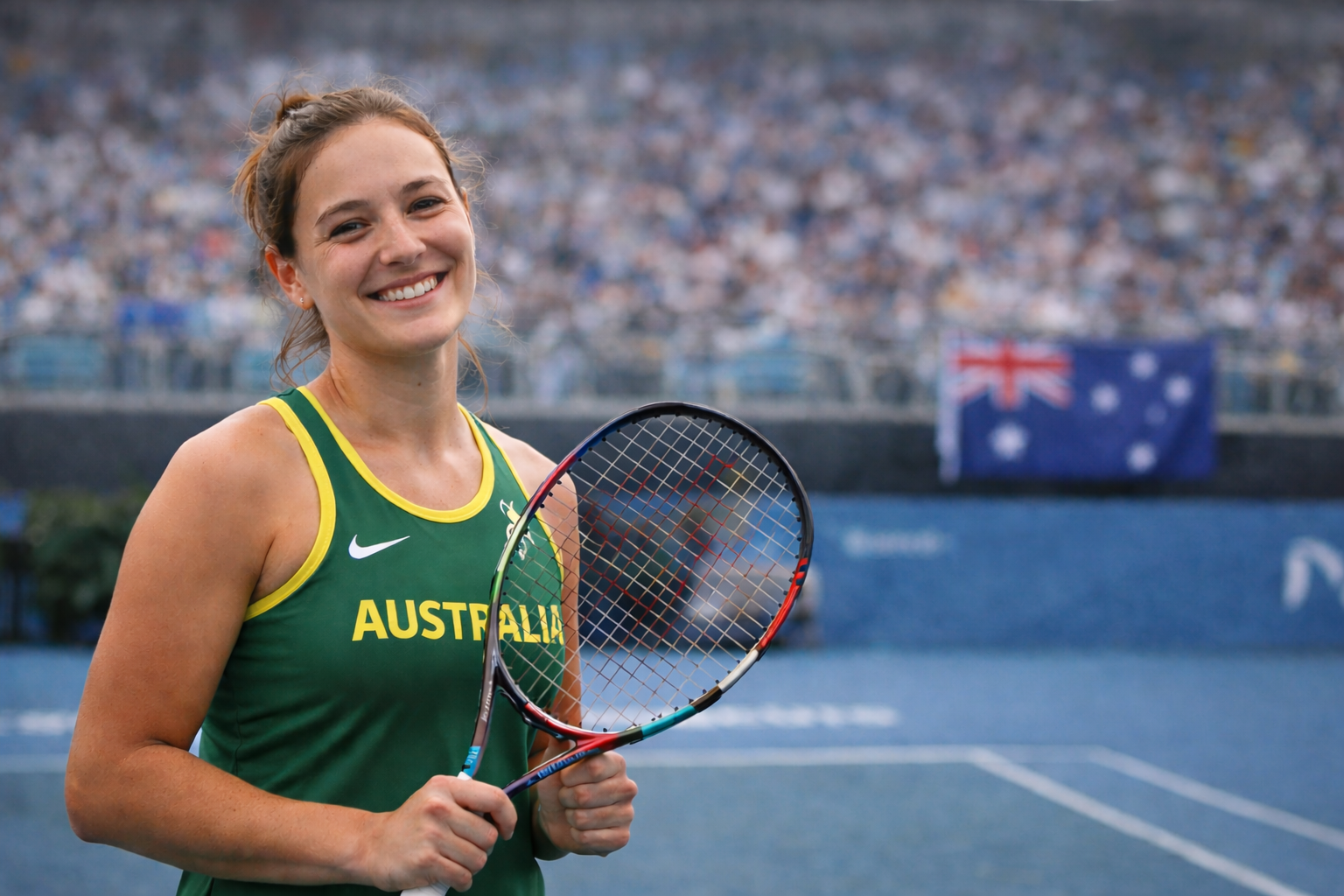
And no, it’s not only because she is young. Australia has had young prospects before. Plenty, in fact. The difference with Joint is that her rise already feels less like a promise and more like a working reality. She has titles. She has ranking proof. She has a real place in the national picture. She is not floating around the edges waiting for a big break. She has already had several of them.
That’s why she matters in the Australian sports conversation now. Not as a vague “watch this space” prospect, but as a proper story in motion. A teenager who moved countries, changed her tennis life, crashed into the top end of the women’s game faster than most people expected, and now carries a different kind of pressure — the kind that comes after success, not before it.
There’s something very appealing about that. And honestly, there’s something a little nerve-racking about it too. Because once a player becomes Australia’s top-ranked woman, the mood changes. People stop asking whether she belongs and start asking how far she can go.
That is a different question. A heavier one. And Maya Joint is now living inside it.
First, the numbers say this is real
Before we get too lyrical about feel and momentum, it’s worth grounding the whole thing in plain facts. Joint is 19. She is ranked No. 29 in singles and No. 34 in doubles on official March 2026 pages. Her singles career high is No. 28, and her doubles career high is No. 33. She won two WTA singles titles in 2025, at Rabat on clay and Eastbourne on grass. She also claimed a WTA 500 doubles title in Abu Dhabi in early 2026.
That is not the résumé of a nice junior hope. That is the résumé of a young pro already finding ways to matter on tour.
It also matters that these wins have not all come in one tidy lane. Clay. Grass. Singles. Doubles. Team tennis. A lot of young players look one-dimensional early on, which is normal. Joint already looks broader than that. Not finished. Just broader.
| Milestone | When it happened | Why it mattered |
|---|---|---|
| Relocated to Australia | Mid-2023 | It changed her training base, support system and whole career direction |
| Top 100 breakthrough | March 2025 | It marked her move from prospect to real tour-level presence |
| First WTA singles title | Rabat, May 2025 | It proved she could finish a big week, not just tease one |
| Second WTA singles title | Eastbourne, June 2025 | Winning on grass showed range and nerve, especially after saving championship points |
| Became Australian No.1 woman | Late 2025 | That changed her place in the national conversation straight away |
| Seeded at Australian Open | January 2026 | It reflected how quickly she had climbed into the tour’s serious bracket |
| Won WTA 500 doubles title | Abu Dhabi, February 2026 | It added another layer to her profile and lifted her doubles standing again |
That table is the short version. The fuller version is more interesting, because her rise did not come out of nowhere.
Michigan to Brisbane is not your standard Aussie tennis path
One of the reasons Maya Joint stands out is that her story does not read like the standard Australian tennis pathway. She was born in the Detroit area and grew up in Michigan. Her father, Michael, is Australian and a former professional squash player. Joint had Australian citizenship already, but the big career turn came when she decided she needed something different from what she was getting in the United States.
So she moved. That’s the blunt version. But the move mattered because it changed the quality of her tennis life. Tennis Australia gave her training opportunities in Brisbane, and by her own account the shift sharpened everything — practice environment, competition, support, the daily feel of being inside a system that believed in where she could go.
That part of the story hits hard in Australia because it fits a very specific sporting fantasy we still love: a talented young athlete comes here, finds the right setup, gets properly stuck into the work, and suddenly the whole thing looks possible. It’s not magic. It’s structure. But structure can look a lot like magic when it works.
And look, it worked. Fast.
In March 2025, a WTA feature noted that one year earlier Joint had been ranked No. 331. A year. That’s all. One year from grinding in lower-level events to becoming a player serious people on the tour were discussing. That sort of jump always catches attention because it suggests a few things at once: a steep learning curve, strong daily habits, and a game that travels better against stronger opposition than some expected.
- She did not rise through a single lucky run.
- She changed environment, and the new environment clearly helped.
- Her progress has had shape, not just hype.
Those are the careers that tend to last longer than people think.
2025 was the year she stopped being a secret
Every rising player has a year where the tennis world stops squinting and starts paying proper attention. For Joint, that was 2025.
She began the season by showing she could already trouble established names. She had a strong week in Hobart, reached a semifinal, and started stringing together wins that pushed her well beyond the “handy young Australian” label. Then came the top 100 breakthrough in March. And once that happened, the rest of the season opened up a bit. Bigger draws. More chances. More pressure too, sure, but more proof.
The Rabat title was huge because first titles always are. They remove a question. Can she finish? Can she hold her nerve on finals day? Can she build a week and not blink at the last fence? She answered all of that in Morocco, beating Jaqueline Cristian in straight sets. And then, because sport likes a little flourish, she won the doubles title there as well.
Then came Eastbourne, and this one probably told us even more. Winning on grass matters. Winning a grass final after saving four championship points matters a lot more. Her Eastbourne title against Alexandra Eala had that proper sports-story feel to it — tense, dramatic, a bit wild, the kind of match people remember because it makes a player seem sturdier than before.
And that’s what Eastbourne did. It did not just give her a second trophy. It gave her a different outline. More complete. More dangerous. More like someone who can adjust to very different conditions and still find a way through.
Why Aussie fans have clicked with her so quickly
There are reasons some athletes connect fast and others don’t, even when the results look similar. With Joint, a few things line up nicely for Australian fans.
First, she feels modern without feeling manufactured. That matters. She does not come across like a giant marketing project. She reads more like a young athlete still figuring things out in public, which people tend to trust more. Second, her game has enough grit in it to feel familiar to Australian tennis fans. There’s not much fluff there. She competes. She absorbs awkward patches. She finds ways back into matches.
Third, timing matters. Since Ash Barty’s retirement, Australian women’s tennis has had talent, depth and strong personalities, but it has also had a visible gap at the very top. Joint has not “replaced” Barty — that would be a silly way to frame anyone — but she has stepped into the space where the top-ranked local woman again becomes a real weekly reference point.
That changes how fans relate to her. She is no longer just one of the names on the list. She is the first name many casual fans now look for.
- She wins on different surfaces, which makes her feel less predictable.
- She has an unusual personal path, which gives the story texture.
- She became Australian No.1 while still a teenager, which naturally turns up the national interest.
Also, and this is not nothing, she is still clearly learning. Fans often enjoy that stage. The flaws are visible, the upside is visible, and the whole thing feels alive.
Her game is not loud, but it bites
Joint is not the sort of player who needs a circus around her tennis. Her game makes sense pretty quickly. She is right-handed, compact, quick around the court and able to shift from neutral to aggressive without making it look theatrical. There’s a steadiness to the base of her game, and then little moments where she changes direction and pace just enough to tilt the rally.
That’s probably one reason her tennis translates across surfaces. On clay, she can stay patient and build. On grass, she has shown she can shorten points when needed and keep her balance when matches get a bit frantic. For a teenager, that adaptability is a very good sign.
She also seems comfortable in the grey area between attack and discipline. Some young players live too far at one end. They either overhit because they want to look dangerous, or they get too careful because they are scared of missing. Joint already looks better balanced than that. Not perfect, obviously, but better balanced.
And then there is the competitive side. You do not save four championship points in an Eastbourne final by accident. That is not luck alone. That is mind, nerve and the ability to keep the match alive one decision at a time.
| Part of her game | What stands out | Why it matters long term |
|---|---|---|
| Movement | She covers the court well and resets points quickly | That gives her a base on slower and faster surfaces |
| Match temperament | She has already shown she can stay composed late in big matches | Young players often need years to build that sort of steadiness |
| Surface adaptability | She won titles on clay and grass in the same season | It hints at a ceiling wider than one-surface specialists usually have |
| Tour resilience | She has improved quickly without looking overwhelmed by the jump | That is one of the clearest markers of genuine tour staying power |
| Doubles value | Her doubles results keep improving alongside singles | That sharpens hands, instincts and big-point confidence |
But here’s the honest bit: early 2026 has been mixed
This is where the story gets more useful and less sugary. Joint’s current ranking is strong, but the start of 2026 in singles has not been one clean victory lap. Official pages show a 2-7 singles record for the year so far, and her Australian Open singles best remains the first round.
That does not erase anything from 2025. It just reminds people how tennis works. Rankings trail performance. Momentum comes and goes. Once you climb into a new band of the tour, every opponent is sharper, the scouting is better, the draws get tougher and the margin for a bad half-hour shrinks. That’s not a crisis. It’s the job.
In a strange way, this slightly bumpier stretch may help the public read her more clearly. She is not arriving as a complete, untouchable product. She is arriving as a very good young player whose next challenge is learning how to live in the top 30 while still improving. That’s harder than breaking in. The tour is full of players who can spike. Staying there is a different art.
And this is where people need to stay patient. Australian sport can be a little too eager to crown, then a little too eager to frown. Joint deserves something better than that. Her 2026 start is not spotless, but it is also not some warning siren. It is part of the normal strain of moving up.
- She still needs deeper Slam runs.
- She still needs more consistency in bigger singles weeks.
- She is still learning how to carry expectation as Australia’s top woman.
That is not a weakness in the story. It is the story.
The doubles thread matters more than people think
There’s an old habit in tennis coverage where doubles achievements get treated like a side note unless the player is a doubles specialist. That’s a bit lazy. In Joint’s case, the doubles thread tells us something valuable about the stage she is in.
She won a doubles title in Rabat alongside Oksana Kalashnikova. Then in February 2026 she picked up a WTA 500 doubles title in Abu Dhabi with Ekaterina Alexandrova. Those are not throwaway add-ons. They show that she is comfortable in different formats, and they probably help her singles more than casual fans realise.
Doubles sharpens reactions. It helps return positioning, instinct at net, point construction under pressure, and the little tactical reads players often need time to learn. It also keeps a player active in tense moments. That can be huge for a young athlete still building a full tour identity.
So no, doubles does not define Maya Joint. But it adds to the case that her tennis brain is maturing fast.
Why she matters to Australian tennis beyond the ranking
Sports stories are rarely only about one player. They are also about what that player represents at a particular moment. Joint arrives at a useful time for Australian tennis.
The country still cares deeply about tennis. That part has never gone away. But the local women’s conversation has been waiting for a clear week-to-week figure again — someone young enough to feel like the future, but good enough already to feel relevant in the present. Joint fits that role more cleanly than anyone else right now.
She is also part of a broader shift in how Australian tennis talent is built. Her path speaks to mobility, system support, global coaching, and the way national identity in sport can be both personal and practical. She is Australian, yes. But her route to becoming Australia’s top woman also says something about how modern athlete development works now. It is less linear, less local in one simple sense, and more shaped by where the right structure happens to be.
That makes her interesting even beyond results. She is a very current kind of athlete in a sport that keeps changing.
And now the pressure gets more specific
At the end of 2025, Joint’s goals for 2026 were pretty clear: win a WTA 500, reach the fourth round of a WTA 1000, and reach the third round of a Grand Slam. Those are not wild fantasies. They are also not freebies.
The Billie Jean King Cup qualifier in Melbourne next month adds another layer. She is due to lead Australia against Great Britain at John Cain Arena. That matters because team tennis asks different questions. Can you carry national expectation? Can you handle the emotional noise of playing at home? Can you be the reference point rather than the side note?
Honestly, that might be one of the most revealing weekends of her year. Not because a single tie defines a player, but because it shows how a rising talent handles visibility when the shirt is green and gold and the crowd is not neutral.
That is the next version of her story. Less about surprise, more about leadership.
FAQ
Who is Maya Joint?
Maya Joint is a 19-year-old Australian professional tennis player who rose quickly in 2025 and is now the country’s top-ranked woman.
What is Maya Joint’s current ranking?
Official March 2026 pages list her at No. 29 in singles and No. 34 in doubles.
Where did she grow up?
She grew up in Michigan in the United States before relocating to Australia in 2023 and training in Brisbane.
What titles has she won?
She won WTA singles titles in Rabat and Eastbourne in 2025, plus notable doubles titles including Rabat and Abu Dhabi.
Why is she such a big story in Australia?
Because she rose quickly, became Australia’s top-ranked woman as a teenager, and looks like a genuine long-term factor on the WTA Tour.
What is her best Australian Open singles result so far?
So far, her best singles result at the Australian Open is the first round, in both 2025 and 2026.
What should fans watch next?
Her next big tests are deeper runs at major events, more consistency in singles, and her leadership role in Australia’s Billie Jean King Cup campaign.
Conclusion
Maya Joint matters because her rise already feels substantial, not theoretical. She has done enough that the excitement around her no longer depends on projection alone. The ranking is real. The titles are real. The Australian No.1 tag is real. And the sense that she might still be only halfway into what she can become — that feels real too.
There is still plenty she has not done. She has not made a deep Grand Slam singles run yet. She has not settled into that smoother week-after-week rhythm the very best players manage. She is still learning how to absorb losses, expectation and the strange attention that comes with being a national sports talking point. But that’s exactly why the story is worth following. It is not finished. It is alive.
For Australian fans, that’s the fun of it. Maya Joint is no longer only the promising name on the edge of the draw. She is part of the centre now. And the next question is not whether she belongs there. It is how much further she can push the whole thing from here.