
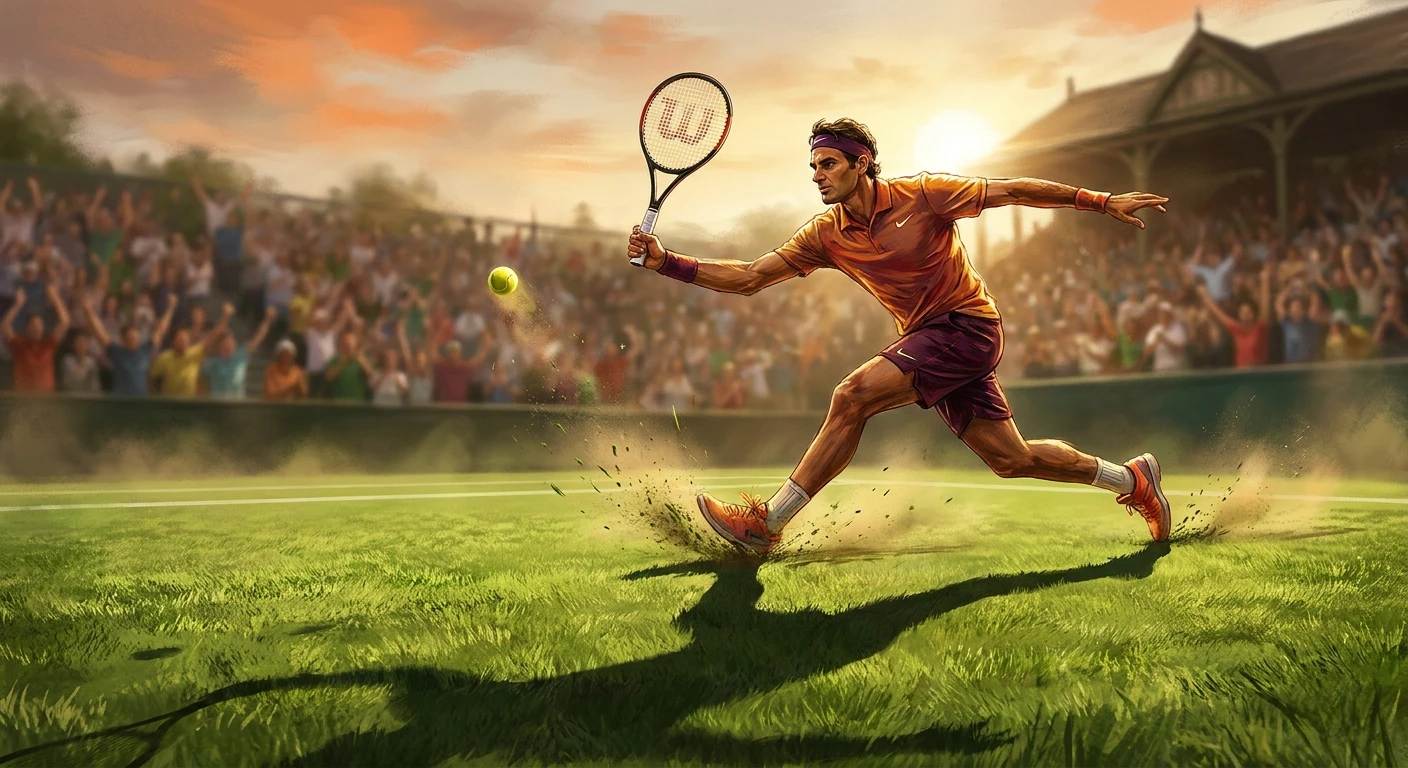
The Anatomy of a De Minaur Wimbledon Campaign
When you analyze the latest De Minaur Wimbledon campaigns, you instantly recognize why playing on professional grass courts demands a totally unique athletic approach. Affectionately known on the tour as the “Demon,” Alex brings a chaotic, high-energy style that perfectly disrupts the traditional grass-court rhythm. His adaptability on the prestigious London turf isn’t just a matter of fast feet; it is a highly calculated blend of biomechanics, strategic flat hitting, and relentless mental endurance.
Grass is notoriously the most volatile surface in professional tennis. The ball skids low, shoots fast off the turf, and often takes unpredictable bounces due to the natural wear and tear of the court over a two-week tournament. Players who rely on massive, looping topspin often find themselves totally out of position here. Alex, however, strikes the ball exceptionally flat and early. His compact swings allow him to redirect pace effortlessly. As we navigate through the intricacies of his game, the core thesis becomes obvious: elite speed combined with a low center of gravity turns defensive scrambles into offensive strikes on grass. Watching him track down drop shots or passing a net-rusher gives you a masterclass in modern athletic performance. You quickly realize that his success on this surface is built on precision, physical conditioning, and an incredible tennis IQ that turns apparent defensive disadvantages into aggressive, match-winning opportunities.
Read also: Amarissa Toth: Tennis Career, Controversy & Future; Emerson Jones: The Rising Tennis Star.
Core Tactics: Why His Game Thrives on Turf
If you watch a fast-paced match at the All England Club, you know that the margin for error is incredibly slim. You cannot just stand three meters behind the baseline and hope to grind your opponent down. The strategic value of Alex’s game lies in his court positioning. He hugs the baseline, taking time away from his opponents. This aggressive positioning forces errors and rushes the decision-making process of players who are used to having an extra fraction of a second on clay or hard courts.
Let’s look at the sheer value proposition of this playing style. First, consider how he plays against heavy servers. Massive servers usually rely on getting a weak return to step in and finish the point. By blocking the return early and keeping the ball completely flat, Alex neutralizes the server’s primary weapon, forcing them into long, grueling rallies where his superior fitness takes over. Second, against baseline grinders, his ability to suddenly inject pace with a flat backhand down the line completely changes the geometry of the court. He creates angles that shouldn’t mathematically exist on a slick surface.
| Tactical Element | Impact on Grass Court | Alex’s Execution Level |
|---|---|---|
| Compact Swings | Handles low bounces effectively without framing the ball. | Elite; rarely gets jammed by deep, fast shots. |
| Baseline Hugging | Steals time from the opponent, rushing their footwork. | Exceptional; uses short steps to stay grounded. |
| Flat Trajectory | Ball skids instead of sitting up, making defense brutal. | World-class; his forehand acts like a laser beam. |
To execute this game plan, a player must master several technical pillars. Here is exactly how he constructs points:
- Court Positioning: Maintaining a strict position right on or slightly inside the baseline to cut off angles.
- Return Strategies: Using a split-step that anticipates the server’s toss, allowing for immediate forward momentum.
- Footwork Dynamics: Employing rapid, microscopic adjustment steps rather than long, sliding strides which can cause slipping on damp grass.
The Evolution of a Grass Court Specialist
Origins of His Grass Court Journey
The foundation of this aggressive style was laid early in his junior career. Growing up playing on various surfaces, his natural foot speed always stood out, but it was his introduction to the lower-bouncing courts that really unlocked his potential. In his junior days, reaching the finals of the boys’ singles at Wimbledon proved that his game naturally translated to the lawn. He didn’t have the sheer brute force of taller peers, so he learned to use their pace against them. This required developing an extraordinary eye-hand coordination to pick the ball up right after the bounce, a skill that remains the bedrock of his current ATP tour dominance.
Evolution of the Demon’s Tactics
As he transitioned to the professional circuit, the physical demands changed drastically. Men hit the ball much harder and heavier. Early on, he sometimes found himself overpowered by the giants of the tour. To adapt, his coaching team focused heavily on adding lean muscle mass without compromising his explosive speed. They also refined his serve. While he doesn’t hit 140 mph bombs, his focus shifted to placement, using the slice serve out wide on the deuce court to open up the grass court and immediately rush the net. Winning ATP titles on grass in places like Eastbourne and ‘s-Hertogenbosch served as critical stepping stones, proving that his tactical shifts were paying massive dividends.
Modern State of His SW19 Campaigns
Fast forward to the 2026 season, and the narrative around his game has fully matured. He is no longer just a fast runner; he is a tactical chess player on the grass. The modern state of his Wimbledon runs highlights a player who understands exactly when to play defensive squash-like shots and when to step in and flatten out a forehand winner. His deep runs in the second week of the tournament are a testament to his physical conditioning. Surviving five-set matches on grass requires immense core strength to stay low for four hours, and his physical preparation is now considered among the absolute best in the sport.
Scientific and Technical Deep Dive
Biomechanics of Low-Bouncing Tennis
Let’s talk about the sheer physics required to play elite tennis on a surface that actively works against vertical bounce. Grass courts have a much lower coefficient of restitution compared to hard courts or clay. When a tennis ball hits the grass, it loses a significant amount of its vertical energy but retains its horizontal velocity. This means the ball skids toward the player faster and stays closer to the ground. From a biomechanical standpoint, hitting this ball requires extreme knee flexion and tremendous strength in the quadriceps and glutes. If a player bends from the waist instead of dropping their hips, they lose their kinetic chain, resulting in weak, arm-heavy shots. Alex manages to keep his chest up and drop his hips dramatically, maintaining a perfect center of gravity that allows him to uncoil rotational energy directly into the ball.
The Physics of the Flat Forehand
The strings and racket setup also play a massive role. The physics of a flat forehand on grass dictates that the ball must pass closely over the net with minimal topspin to maximize the skidding effect upon landing. If you apply too much topspin (the Magnus effect), the ball dips sharply but also kicks up slightly higher after the bounce, putting it right in the strike zone of the opponent. By hitting through the ball rather than brushing up the back of it, the trajectory is linear.
- Friction Coefficient: Grass offers lower friction, meaning the ball slides horizontally. Flat shots amplify this effect exponentially.
- Kinetic Chain: Energy transfer starts from the toes gripping the turf, moves through the flexed knees, rotates the hips, and snaps through the wrist.
- String Tension: Lower string tension is sometimes used to create a slight trampoline effect, helping to generate pace when blocking fast serves.
- Reaction Time: The visual processing speed required to track a green ball on a green background moving at 100+ mph pushes human neurological limits.
Actionable Plan: Train Like a Grass Court Pro
If you want to adopt this lightning-fast, aggressive style into your own game, you need a structured approach. Here is a 7-day training protocol inspired by professional grass-court preparation.
Day 1: Sprint Mechanics
Your first day focuses entirely on explosive speed. Professional grass tennis is about the first two steps. Set up cones five meters apart and practice explosive lateral movements. Focus on staying on the balls of your feet. The goal is rapid acceleration and abrupt deceleration without losing balance.
Day 2: Low-Center-of-Gravity Drills
Today is about leg strength and posture. Perform medicine ball throws while maintaining a deep squat position. On the tennis court, do feeding drills where every ball is intentionally hit at your ankles. You must bend your knees, not your waist, to dig the ball out, maintaining a strong, stable core throughout the swing.
Day 3: Flat Groundstroke Repetitions
Transition to racket work with an emphasis on swing path. Eliminate the extreme looping wind-up. Keep the racket head on the same plane as the incoming ball. Have a partner feed balls flat and fast, and practice punching them back with short, compact strokes. Focus heavily on hitting straight through the ball.
Day 4: Return of Serve Anticipation
The return is your most potent weapon. Stand just inside the baseline. Have a server hit flat serves at you. Practice split-stepping right before contact and immediately moving forward. Block the ball back using the server’s pace. Do not try to take massive swings; just redirect the energy into deep court placement.
Day 5: Slice and Approach Shots
You need variety to survive on grass. Work on a biting backhand slice. The racket should carve under the ball, imparting backspin that makes the ball completely die on the turf. Follow these slice shots directly to the net, practicing your split-step at the service line before executing crisp, punchy volleys.
Day 6: Match Play Simulation
Put everything together in practice sets. Play points strictly focusing on attacking the net and keeping rallies under five shots. Reward yourself for taking the ball early and stepping inside the baseline. Pay attention to how your legs feel when staying low for an extended period of time.
Day 7: Active Recovery and Film Study
Professional conditioning requires rest. Engage in active recovery like swimming or light cycling. Spend an hour watching match film of top grass-court players. Analyze their footwork patterns, where they position themselves on second-serve returns, and how they use the slice to transition from defense to offense.
Myths and Reality of Grass Court Tennis
The tennis community holds many misconceptions about how modern grass works. Let’s clear up a few of them.
Myth: Only massive servers can win on grass.
Reality: While a big serve helps, incredible returners who move rapidly and take the ball early consistently neutralize big servers. Speed and low-ball handling are actually the ultimate equalizers on this surface.
Myth: You cannot hit topspin at all on grass.
Reality: Topspin is still absolutely necessary for control and keeping the ball in the court, but players modify their swings to hit a “flatter topspin”—a driving ball rather than a looping one.
Myth: Players can’t slide on grass courts like they do on clay.
Reality: Modern players have adapted their movement patterns to execute micro-slides even on grass, utilizing the specialized pimpled soles of their grass-court shoes to control the deceleration safely.
Frequently Asked Questions
Has Alex ever won Wimbledon?
While he hasn’t lifted the senior singles trophy at SW19, his deep runs and relentless style have firmly established him as a premier threat on the surface, pushing the absolute best players to their limits.
What makes his game so perfectly suited for grass?
His extreme foot speed, ability to take the ball exceptionally early, and his remarkably flat groundstrokes that skid viciously on the slick turf.
Which racket brand does he use during these tournaments?
He trusts Wilson rackets, specifically models that give him a blend of control and feel to redirect massive pace effectively.
Who primarily coaches his grass-court strategy?
Adolfo Gutierrez has been a longtime mentor and coach, instrumental in developing his tactical maturity and physical resilience.
Does he participate in the doubles events at Wimbledon?
Yes, he has played doubles in the past, which sharply hones his reflexes, volleys, and net-transition skills for his singles campaigns.
How exactly does he handle players who serve 130 mph?
By employing elite anticipation, a perfectly timed split-step, and compact return mechanics that use the opponent’s power against them.
Where can fans usually watch his SW19 matches?
His matches are broadcast globally on major sports networks and official streaming platforms that carry the Grand Slam broadcasting rights.
Understanding the sheer depth of a De Minaur Wimbledon campaign gives you a profoundly new appreciation for the sport. It isn’t just about hitting a yellow ball; it is high-speed athletic chess played on an ever-changing organic surface. If you want to elevate your own tennis IQ, start applying these flat-hitting and aggressive positioning concepts during your next court session, and keep watching how the professionals navigate the beautiful complexities of lawn tennis.