The Truth About Disneyland Australia
Rumors of Disneyland Australia have circulated for decades, sparking endless debates among theme park enthusiasts, real estate speculators, and tourism boards. Whenever a large plot of land goes up for sale near Sydney or Melbourne, social media lights up with whispers of a magical kingdom finally making its way down under. You have likely heard the persistent claims that executives are secretly scouting locations or negotiating with local councils. The reality, however, is far more complex than a simple real estate transaction. Building a mega-resort requires a perfect alignment of geographic, economic, and logistical factors. Australia presents a fascinating paradox for global entertainment conglomerates. On one hand, it boasts a highly developed economy, a robust tourism sector, and a population that enthusiastically consumes international pop culture. On the other hand, the nation is geographically isolated from massive neighboring populations, and its own citizens are spread across a vast, relatively sparsely populated continent. Understanding why an official park has not yet broken ground requires looking past the viral clickbait and examining the hard facts of resort development, urban planning, and corporate strategy. The dream remains alive for millions of fans, but the pathway to realizing that dream is paved with immense bureaucratic and financial hurdles.
The Economic Impact and Value Proposition of Mega-Resorts
When a globally recognized entertainment brand establishes a permanent footprint in a new country, the economic ripple effects are staggering. A mega-resort does not merely operate as an isolated attraction; it functions as an economic anchor that reshapes the surrounding region. The value proposition of such a project extends far beyond ticket sales. It includes massive job creation during both the construction and operational phases, a permanent boost to local hospitality sectors, and a significant increase in international flight traffic. You can look at established international parks to understand this scale. Two primary examples highlight this value. First, the European expansion in the early 1990s completely transformed the Marne-la-Vallée region near Paris, turning agricultural land into a massive transit and tourism hub that employs thousands of permanent residents. Second, the Oriental Land Company’s partnership in Japan proved that a well-placed international park can sustain massive, year-round attendance regardless of seasonal weather fluctuations, generating billions in peripheral revenue for local transit and retail sectors.
Read also: Mastering brisbane house prices Fast; Navigating A Bus Strike: Impact, Solutions, And Urban Mobili.
| Resort Location | Geographic Catchment Strategy | Estimated Annual Attendance Potential |
|---|---|---|
| Paris, France | Pan-European rail network connectivity | 14 to 15 Million Visitors |
| Tokyo, Japan | High-density metropolitan transit proximity | 25 to 30 Million Visitors |
| Proposed Australian Site | Domestic flights and regional driving access | To be determined (requires high tourist influx) |
To fully grasp why replicating this success in Oceania is so difficult, we need to examine the core hurdles that currently block development. The barrier to entry for a project of this magnitude is astronomically high, primarily due to three fundamental challenges:
- Population Density and Catchment Areas: Theme parks require millions of people living within a two-to-three-hour driving radius to sustain weekday operations during the off-season school months. Australia’s population centers are heavily coastal and relatively small compared to North American or Asian megalopolises.
- Infrastructure and Labor Costs: Constructing a sprawling, highly themed environment requires a specialized workforce. The cost of labor, materials, and stringent building codes in Australia makes the initial capital expenditure significantly higher than in developing markets.
- Domestic Competition: The Gold Coast already features a deeply entrenched theme park industry. Entering this specific market means competing directly with established domestic operators for the same limited pool of local tourists.
The Origins of the Aussie Disney Dream
The speculation surrounding an Australian expansion is not a recent phenomenon born of social media. The origins trace back to the late 1980s and early 1990s, a period when global entertainment companies were aggressively looking to diversify their real estate portfolios outside of the United States. During this era, the Gold Coast was rapidly cementing its reputation as the entertainment capital of the Southern Hemisphere. Local politicians and developers frequently floated the idea of securing a major international partner to anchor new tourism precincts. Early rumors suggested that large tracts of sugarcane fields were being quietly surveyed by overseas holding companies. While these early whispers generated massive media attention in regional newspapers, no official master plan was ever submitted to the local councils.
Evolution of the Theme Park Proposals
As the new millennium approached, the rumors shifted southward. Following the massive infrastructure investments made for the 2000 Sydney Olympics, speculation arose that the vacant lands surrounding the Olympic park could be repurposed into an entertainment district. The narrative evolved from a beachside tourist trap to a sophisticated, globally connected destination. Urban planners and armchair economists argued that Sydney offered the international flight capacity and domestic population base required to support a year-round operation. However, corporate strategy during this period pivoted sharply toward the rapidly expanding Asian middle class. Investments were channeled into Hong Kong and later Shanghai, regions offering immediate access to hundreds of millions of potential guests, leaving the Australian proposals to languish as purely hypothetical exercises in urban design.
The Modern State of the Rumor Mill
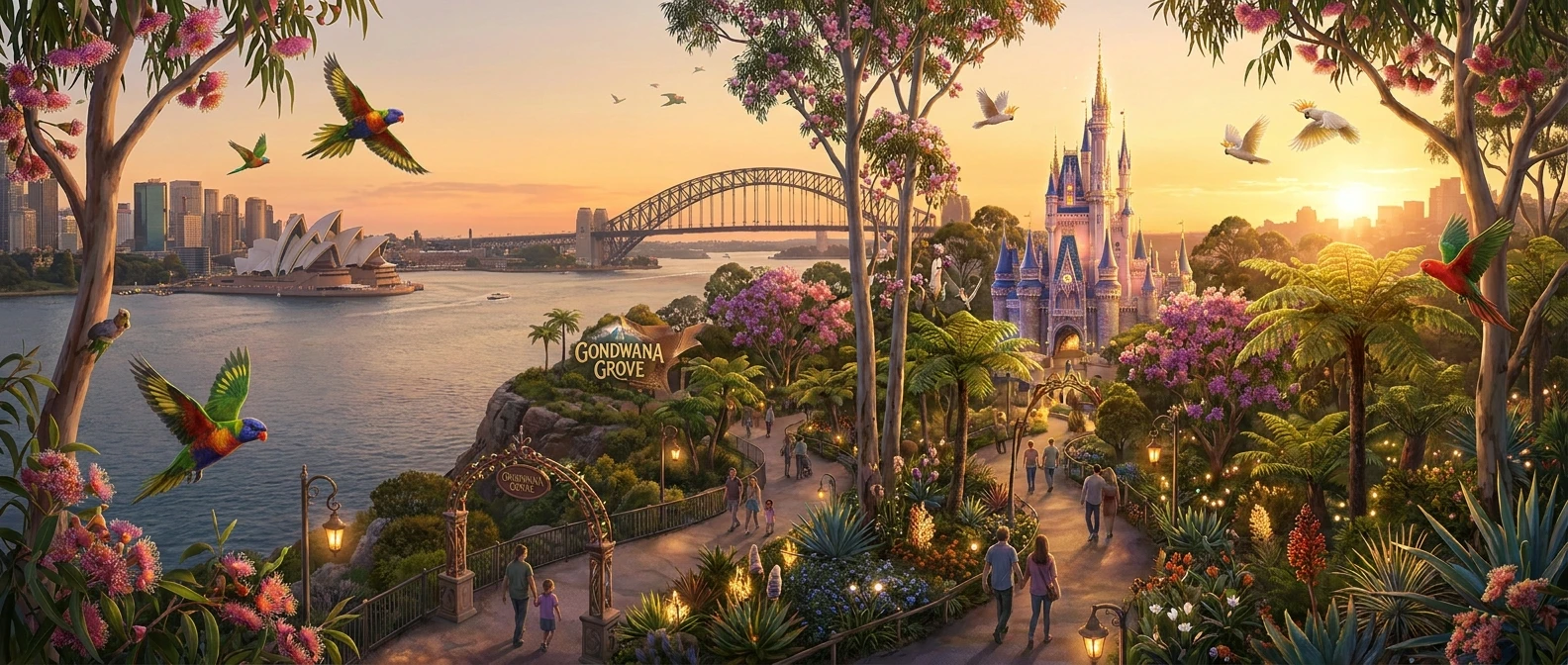
Today, the conversation is largely driven by digital content creators, speculative real estate blogs, and viral April Fools’ Day pranks. Every few years, a digitally altered image of a fairytale castle superimposed over the Melbourne Docklands or the Sydney Harbour goes viral, prompting a fresh wave of media inquiries. The corporate entities involved consistently maintain a standard public relations stance: they are always looking for new opportunities to expand their brand globally, but have no current plans to announce a project in Australia. Despite the lack of official confirmation, the enduring nature of these rumors speaks to a massive, untapped cultural demand. Fans continue to analyze land purchases and corporate trademark filings, hoping to find the hidden blueprint that will finally bring the magic to their shores.
Economic Feasibility and Catchment Areas
Understanding the science of theme park economics requires looking at the concept of the catchment area. In urban engineering and tourism economics, a catchment area is the geographic radius from which a business expects to draw its primary customer base. For a multi-billion-dollar resort to remain solvent, it cannot rely solely on international tourists who visit once in a lifetime. It needs a massive, hyper-local population that holds annual passes, visits on random Tuesday afternoons, and continuously buys food and merchandise. The mathematical modeling used to determine this viability is incredibly rigorous. Analysts calculate discretionary income levels, average local transit times, and regional birth rates. When applied to the Australian landscape, the data presents a stark reality. While Sydney and Melbourne are large, thriving cities, the surrounding regional populations drop off drastically compared to the densely packed corridors of Europe, California, or Eastern China.
Urban Engineering and Infrastructure Requirements
Beyond economics, the physical engineering required to build and sustain a mega-resort is akin to designing a small, self-sufficient city. A modern park requires unprecedented infrastructure to handle daily operations smoothly without collapsing the local municipal grid. The technical load on local utilities is immense. Engineers must account for massive peak-hour power consumption, high-capacity water filtration for lagoons and rides, and specialized waste management systems that operate invisibly to the guests. Furthermore, the transportation logistics require dedicated highway off-ramps, heavy rail connections, and potentially new airport transit links to funnel tens of thousands of people in and out of the gates simultaneously without causing gridlock.
- Minimum Acreage: A viable resort requires hundreds of acres not just for the park itself, but for backstage facilities, maintenance bays, employee parking, and future expansion pads.
- Water Management: Themed environments often require closed-loop water circulation systems that process millions of gallons daily, necessitating advanced ecological engineering to prevent local water table depletion.
- Throughput Optimization: Ride capacity is calculated scientifically to ensure that the park can absorb massive crowds. If a park cannot process enough guests per hour, wait times skyrocket, guest satisfaction plummets, and return visitation drops.
- Climate Resilience: Structures must be engineered to withstand local extreme weather, which in the context of Australia means strict adherence to bushfire safety zones, extreme heat mitigation for outdoor queues, and UV-resistant materials for all external facades.
Step 1: The Initial Feasibility Study
If a project of this scale were ever to be approved, it would follow a highly structured, multi-year blueprint. The first phase is the internal feasibility study. Corporate analysts spend years silently gathering data on a target region. They model economic forecasts, assess currency stability, and measure the long-term political climate. This step happens entirely behind closed doors, often utilizing third-party proxy firms to prevent land speculation.
Step 2: Covert Site Selection
Once the economic model proves viable, the focus shifts to geography. The ideal site requires a massive contiguous block of undeveloped land positioned near major transit arteries. To prevent a sudden spike in real estate prices, the parent company typically utilizes dummy corporations to slowly purchase adjacent parcels of land over several years until the necessary footprint is secured.
Step 3: High-Level Government Negotiation
A project of this magnitude cannot proceed without significant government backing. Executives engage in complex negotiations with state and federal officials to secure tax incentives, infrastructure subsidies, and zoning exemptions. The company argues that the long-term tax revenue and job creation justify the initial public investment in roads and rail lines leading to the resort.
Step 4: Strict Environmental Clearance
Before any earth is moved, the project must pass rigorous environmental impact assessments. In a biologically diverse environment, this means mapping out native flora and fauna, establishing protected wildlife corridors, and proving that the massive influx of tourists will not degrade the local ecosystem. This phase can take years of public hearings and revisions.
Step 5: The Master Planning Phase
With the land secured and legally cleared, specialized creative engineers begin the master planning. This is where the physical layout of the park is finalized. Sightlines are calculated to ensure guests cannot see the outside world, underground utility corridors are mapped out, and the structural engineering for massive centerpieces is finalized to meet local safety codes.
Step 6: Heavy Vertical Construction
Only after years of planning does vertical construction begin. This phase requires thousands of specialized contractors, from structural steelworkers building roller coaster supports to artisans sculpting artificial rockwork. The construction site operates like a massive military logistics campaign, carefully coordinating the delivery of custom ride systems manufactured across the globe.
Step 7: Extensive Cast Member Recruitment
The final step before opening involves recruiting and training a massive workforce. The local labor pool must be trained in highly specific operational protocols and customer service standards. This phase includes extensive soft openings and technical rehearsals to ensure every restaurant, ride, and retail location functions perfectly under the pressure of real crowds.
Debunking Myths and Finding Reality
The void of official news has allowed a robust mythology to develop around the concept of an Australian park. It is crucial to separate verified facts from internet fiction. Myth: The corporation secretly bought a massive tract of land in regional Victoria ten years ago. Reality: Comprehensive searches of state land registries and corporate disclosures show no such massive acquisition by the holding company. Myth: A fully designed park was canceled at the last minute because executives were terrified of Australian spiders and snakes. Reality: While environmental management is a standard part of any construction project, the primary barriers to development are strictly financial and demographic, not wildlife-related. Myth: A massive announcement is coming next year to replace a struggling local park on the Gold Coast. Reality: Existing domestic parks are owned by separate corporate entities, and global entertainment giants typically prefer building bespoke infrastructure from scratch rather than retrofitting older, competing facilities.
Frequently Asked Questions
Is an official park currently confirmed for Australia?
No. There are currently no official announcements, confirmed plans, or active construction projects for a new mega-resort in the country.
Where would a potential park most likely be located?
Hypothetically, it would need to be near a major international transit hub with vast amounts of affordable, developable land, making the outskirts of Sydney or the Gold Coast the most logical academic choices.
Why doesn’t Australia already have one?
The main factors are a relatively small domestic population spread across a massive continent, making the catchment area economics incredibly difficult to justify compared to Asian or European markets.
How much would a new park cost to build?
Modern mega-resorts cost billions of dollars to design, engineer, and construct, heavily dependent on local labor rates and infrastructure requirements.
Did executives ever try to build in Sydney?
There were heavily publicized rumors and speculative proposals around the time of the 2000 Olympics, but no definitive corporate action was ever formalized or approved.
What are the best alternatives currently in Australia?
The Gold Coast remains the premier destination for domestic theme parks, offering a wide variety of high-quality roller coasters, water parks, and movie-themed attractions.
Will we ever get an official announcement?
The entertainment industry is constantly shifting. While it seems unlikely in the immediate short term due to current economic climates, long-term global expansion strategies are always subject to change.
Conclusion
The prospect of Disneyland Australia remains one of the most enduring and fascinating topics in the global entertainment industry. While the economic realities, immense infrastructure requirements, and geographical challenges currently keep this dream on the drawing board, the passion of the fans proves that the market demand is undeniable. Understanding the strict scientific and economic hurdles provides a much clearer picture of why these massive projects take decades to materialize, if they ever do at all. Until the financial models align with the geographic realities, we will have to rely on international travel to experience the magic. Keep the conversation going, share this analysis with your fellow theme park enthusiasts, and never stop dreaming of what the future of entertainment might hold!