
Exactly how much caffeine in matcha are you drinking?
So, you are standing at your favorite café counter, staring at that vividly bright green powder, and thinking to yourself, exactly how much caffeine in matcha am I about to consume? You are definitely not the only one asking this question. Just last week, I was hanging out at this tiny underground coffee spot in Kyiv’s Podil district. The barista, knowing I usually run on three heavy espressos by noon, challenged me to swap my usual anxiety-inducing brew for a traditional bowl of ceremonial grade green tea. I was incredibly skeptical. I need my morning kick, and I honestly thought a cup of green tea wouldn’t even make a dent in my fatigue. But then she explained the actual math behind the powder, and I realized I had it all entirely wrong.
Now that we are solidly in 2026, the local coffee scene has shifted hard toward sustainable, jitter-free energy alternatives. Everyone seems to be carrying around a bamboo whisk. But the confusion remains. People assume that because it is technically a tea, it must be weak. Or, conversely, they hear it gives you hours of focus and assume it is packed with more stimulants than an energy drink. The truth sits right in the middle, wrapped in some absolutely fascinating plant biology. This guide gives you the precise numbers you need, breaks down the science behind that famously smooth energy curve, and provides a completely practical, step-by-step roadmap to switching up your daily brewing routine without suffering from withdrawal headaches. Let’s get straight to the facts.
The Core Numbers: What You Are Actually Sipping
When we talk about the specific stimulant content, the numbers are surprisingly consistent if you are using decent quality powder. On average, a standard gram of high-quality matcha contains between 30 and 40 milligrams of caffeine. A typical serving—the amount you would get if you ordered a latte at a shop or made a traditional bowl at home—uses about two grams, which is roughly half a teaspoon. That means you are looking at a total of 60 to 80 milligrams of caffeine per cup. To put that into perspective, your average cup of drip coffee hits you with about 95 to 140 milligrams, while a single shot of espresso hovers around 63 milligrams.
So, a standard serving of this green powder actually rivals a shot of espresso. But the real value proposition is not just the raw milligram count; it is how your body uses it. Because you are consuming the entire ground-up tea leaf rather than just steeping it in water and throwing the leaf away, you get a massive dose of amino acids that completely change the way the stimulant interacts with your nervous system. Here are two quick examples of how this plays out in real life:
Example 1: The Morning Rush. Instead of feeling a sharp spike of anxiety thirty minutes after your morning cup, you get a steady, climbing sense of alertness. You don’t get the sweaty palms or the racing heart.
Example 2: Pre-Workout Focus. Many athletes have started using it before hitting the gym. It provides enough physical energy to lift heavy, but keeps the mind locked in and focused, preventing the post-workout crash.
| Drink Type | Standard Serving Size | Estimated Caffeine (mg) |
|---|---|---|
| Ceremonial Matcha | 1 cup (2g powder) | 60 – 80 |
| Brewed Black Coffee | 1 cup (8 oz) | 95 – 140 |
| Steeped Green Tea | 1 cup (8 oz) | 25 – 45 |
If you want to measure your intake accurately at home, you need to follow a few basic rules. The strength of your drink depends entirely on your preparation method.
- Check your scoop size closely: A traditional bamboo scoop (chashaku) holds about one gram per scoop. You need two scoops for a standard serving. If you are using a regular baking teaspoon, use exactly half.
- Factor in your water temperature: Never use fully boiling water. Water at 175°F (80°C) perfectly extracts the stimulants and the sweet flavors without pulling out the bitter, astringent compounds.
- Know your grade: Ceremonial grades are made from the youngest leaves at the very top of the tea plant, which naturally contain higher levels of caffeine to protect themselves from insects. Cheaper culinary grades use older, lower leaves, which have slightly less stimulant content but a much harsher flavor.
Origins in Ancient China and Japan
To understand why this specific plant packs such a unique punch, we have to look backward. The practice of grinding tea leaves into a fine powder didn’t start as a modern health trend. It actually traces all the way back to China’s Tang Dynasty (618–907 AD). During this era, tea leaves were steamed and formed into solid bricks for easy transport and trade. When it was time to drink, pieces of the brick were broken off and roasted, then ground into a fine powder and whisked into boiling water. It was an incredibly efficient way to get every single nutrient out of the plant. Later, in the 12th century, a Japanese Buddhist monk named Eisai traveled to China, discovered this powdered tea method, and brought the seeds—along with the specific preparation techniques—back to Japan. He famously wrote about tea as a divine medicine that could synchronize the mind and body.
The Evolution of Shade-Grown Leaves
Once the seeds were planted in Japan, the cultivation method evolved dramatically. Japanese farmers discovered that if they covered the tea plants with heavy shading materials for about three to four weeks before the spring harvest, the plant would panic. Starved of sunlight, the tea bushes would desperately pump out massive amounts of chlorophyll to capture whatever faint light was available. This shading process is exactly what gives the powder its brilliant, neon green color. More importantly for our purposes, the lack of sunlight forces the plant to produce and retain significantly higher levels of amino acids, particularly L-theanine, and pushes the caffeine levels up. The plants literally chemically alter themselves in the dark.
The Modern State of Green Energy
Fast forward to the current day, and the global obsession with this ancient drink has reached peak levels. We aren’t just drinking it in quiet tea ceremonies anymore. It is being thrown into smoothies, baked into croissants, and mixed with oat milk in thousands of drive-thrus. But because of this mass commercialization, the quality varies wildly. Many coffee chains use pre-sweetened mixes that contain more refined sugar than actual tea, heavily diluting the energy benefits and the natural chemical balance. Finding authentic, pure powder requires a bit of label-reading, but the payoff for your daily energy levels is massive when you secure the real deal.
The L-Theanine Synergy
Let’s talk about the actual biology happening in your brain. The main reason this drink feels so completely different from a highly caffeinated energy drink is an amino acid called L-theanine. This compound is incredibly rare in nature, found almost exclusively in tea plants and a few specific types of mushrooms. When you consume caffeine by itself, it quickly crosses the blood-brain barrier, blocking adenosine receptors to stop you from feeling tired, while simultaneously triggering the release of adrenaline. That is the jittery rush. L-theanine steps in and modifies this process entirely. It promotes the generation of alpha brain waves—the exact same electrical patterns your brain produces when you are in a state of deep meditation or intense creative flow. The combination creates a state often described as ‘relaxed alertness’. You are wide awake, but your central nervous system remains calm.
Pharmacokinetics: The Caffeine Release Curve
Beyond the calming effect, the actual physical delivery system of the stimulant is altered by the plant’s structural compounds. When you drink coffee, the stimulant hits your bloodstream rapidly, peaking in about thirty to forty-five minutes and crashing hard a few hours later. The green tea powder operates on a totally different timeline. Here are the hard scientific facts regarding how your body processes it:
- Catechin Binders: The high concentration of antioxidants, specifically catechins like EGCG, physically bind to the caffeine molecules in your digestive tract.
- Slow Absorption: Because of these molecular bonds, the stimulant is slowly released into your bloodstream over a period of four to six hours, rather than hitting you all at once.
- Lower Cortisol Spikes: The gradual release prevents the massive spikes in cortisol (the stress hormone) that are typically triggered by black coffee.
- Cellular Support: The massive dose of antioxidants works to neutralize free radicals in real-time, supporting your cellular health even as your body processes the stimulant.
Day 1: The Half-and-Half Strategy
If you want to transition your daily routine, you absolutely cannot quit your dark roasts cold turkey. On the very first day, maintain your morning routine. Have your usual brew right when you wake up. Then, when the dreaded 2 PM afternoon slump hits, do not reach for a second cup of Joe. Instead, whisk up a warm bowl of green tea. This introduces your system to the new energy curve without triggering a massive morning withdrawal headache.
Day 2: Dialing in the Ratios
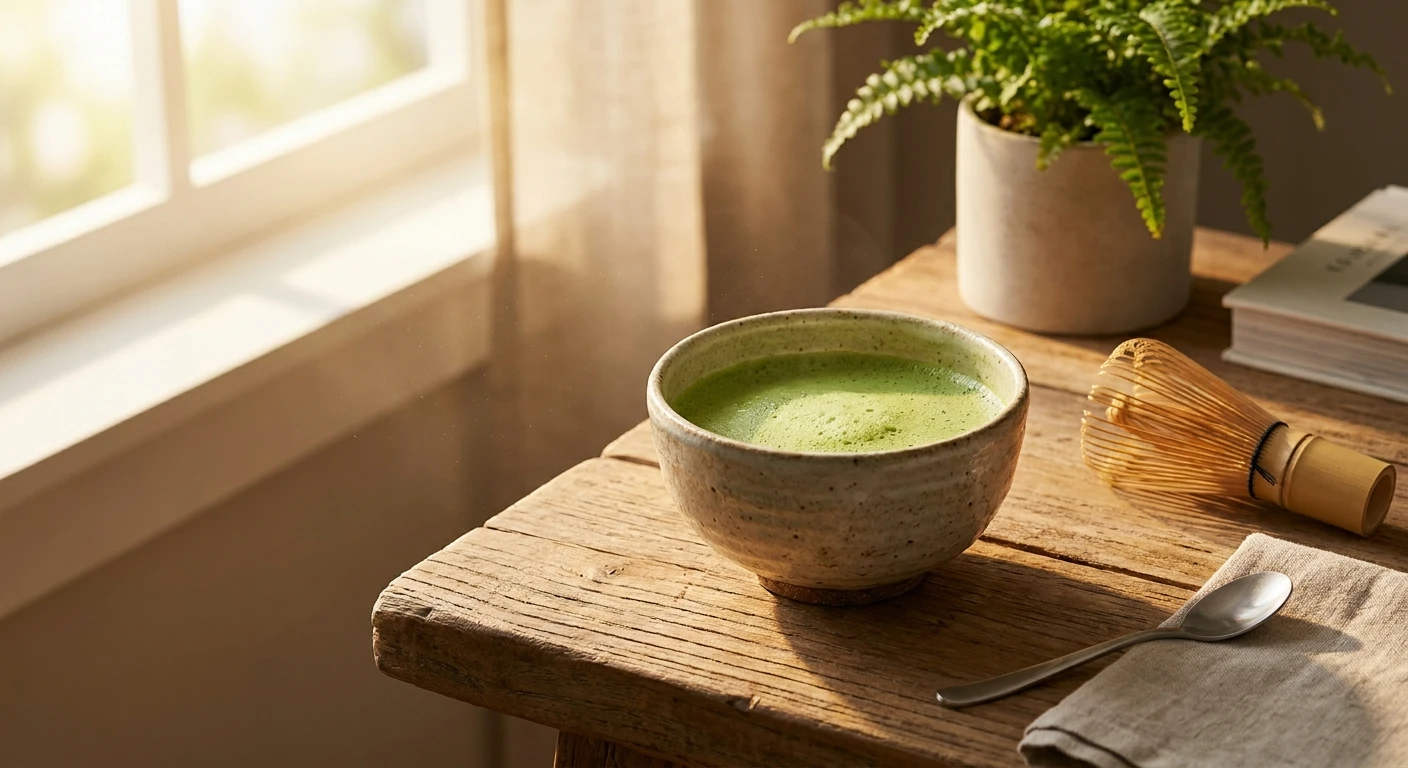
Now that you have felt the afternoon lift, it is time to focus on the preparation mechanics. Go out and get a proper bamboo whisk (chasen). Try making a bowl using exactly two grams of powder and two ounces of hot water (175°F). Whisk it vigorously in a ‘W’ shape until a thick, frothy foam forms on top. The better the foam, the sweeter the flavor.
Day 3: The Cold Brew Experiment
Your body is adjusting. Today, try it iced. Cold water extraction pulls out even fewer bitter tannins, making the drink incredibly smooth. Put two grams of powder in a shaker bottle with some cold water and a few ice cubes, and shake aggressively for thirty seconds. It is the perfect crisp, refreshing energy boost.
Day 4: Sweetener Detox
If you have been adding vanilla syrups or heavy scoops of sugar, today is the day to stop. Sugar aggressively spikes your blood glucose, which completely ruins the smooth, sustained energy curve you are trying to build. If you absolutely need sweetness, use a tiny drop of natural honey or maple syrup.
Day 5: Pre-Workout Power
Time to test the physical benefits. Thirty minutes before you hit the gym or go for a run, drink a standard serving. Pay very close attention to your heart rate and your endurance. You should notice that you have plenty of stamina, but your chest doesn’t feel like it is vibrating out of your skin the way it does with synthetic pre-workout powders.
Day 6: Exploring Culinary Grade
Give your wallet a break. Ceremonial grade is expensive. Today, buy a high-quality culinary grade and use it strictly for blending. Throw a spoonful into a morning protein smoothie with half a banana, some spinach, and almond milk. The fat and fiber will slow down the energy release even further, giving you a solid eight hours of stable alertness.
Day 7: The Full Switch
You are ready. Wake up, skip the coffee maker entirely, and go straight for the bamboo whisk. Make a pure, warm bowl of ceremonial goodness. Notice how your stomach feels less acidic, your mind feels sharper, and your energy lasts smoothly all the way until lunchtime. You have successfully rewired your caffeine dependency.
Separating the Myths from the Reality
Myth: The green powder is completely caffeine-free.
Reality: It actually contains a very solid amount of stimulants, often significantly more than regular steeped green tea bags. Do not drink it right before bed expecting a sleepy herbal tea experience.
Myth: The energy hit is exactly the same as an espresso shot.
Reality: While the milligram count is quite similar to a single shot, the actual physical energy is drawn out smoothly over four to six hours rather than delivering a fast, aggressive one-hour spike.
Myth: Boiling water gets more energy out of the powder.
Reality: Using boiling water just severely burns the delicate, finely ground leaves. It destroys the antioxidants, neutralizes the calming L-theanine, and makes the resulting drink taste incredibly bitter and swampy.
Frequently Asked Questions
Is it safe to drink during pregnancy?
Most medical professionals suggest limiting overall intake to under 200mg per day during pregnancy. Since a standard bowl has about 70mg, one cup is usually perfectly fine, but always consult your doctor first.
Can young children drink it safely?
It is generally not recommended for young children due to the high stimulant content, which can heavily interfere with their sleep patterns and developing nervous systems.
Will this bright green powder stain my teeth?
While any dark or deeply colored beverage can cause some discoloration over time, it is significantly less acidic and less likely to deeply stain your teeth compared to black coffee or red wine.
How late in the day can I safely drink it?
Because the energy release is so slow and sustained, you should try to finish your last bowl by 2 PM to ensure the stimulant is fully cleared from your system before bedtime.
Does culinary grade have less of a kick?
Yes, slightly. Because it is harvested from older, lower leaves on the plant, it naturally contains a slightly lower concentration of both stimulants and amino acids compared to ceremonial top leaves.
Is a bamboo whisk actually required?
While you can technically use a metal milk frother or a shaker bottle, the bamboo whisk is highly recommended. It breaks up tiny micro-clumps better than anything else and creates a specific texture you cannot replicate otherwise.
Can I mix it with heavy milk or cream?
Absolutely. Plant-based milks like oat or macadamia work exceptionally well because they complement the earthy flavor without overpowering the delicate sweet notes of the tea.
At the end of the day, understanding the exact numbers behind your morning brew gives you total control over your energy levels. You get the robust kick of an espresso, perfectly balanced by ancient plant biology that keeps you entirely calm and focused. Go grab your whisk, mix up a fresh bowl today, and experience the remarkably smooth difference for yourself!